US Midterms 2026 Election Day: Voting Underway as Democrats Lead Final Polls
Voting is underway in the US midterms on 3 November 2026, with all 435 House and 35 Senate seats on the ballot, more than 51 million early votes cast, and Democrats leading the final polls — but the Senate resting on tied and single-digit battleground races.

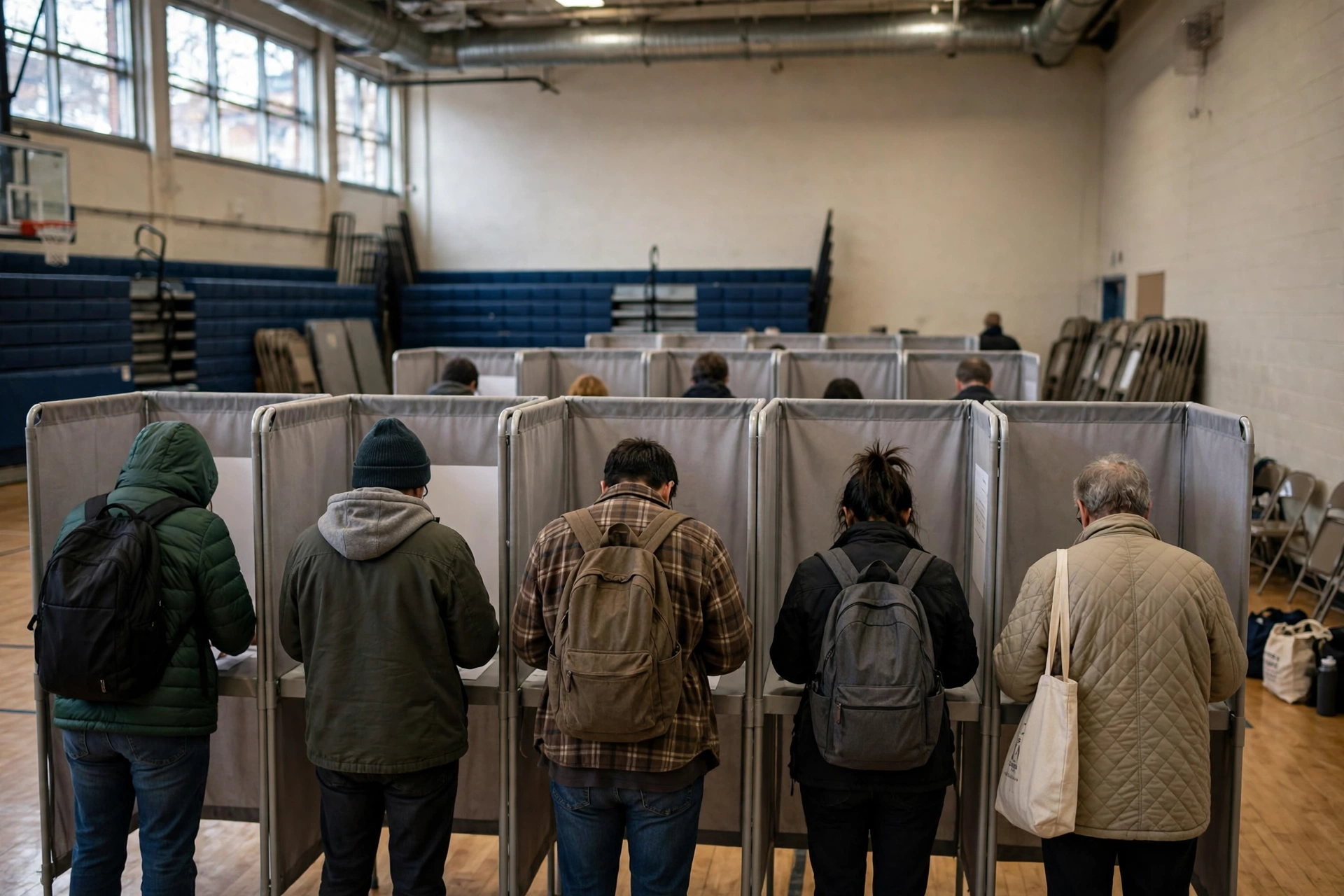
Voting is underway across the United States on Tuesday, 3 November 2026, in midterm elections that will decide control of Congress for the final two years of President Donald Trump’s second term. Democrats go into Election Day leading Republicans in the final national polls, but the Senate in particular will be settled by a handful of close state races, not by the national numbers.
Highlights
- What is on the ballot: All 435 House seats and 35 Senate seats.
- Final national picture: Democrats lead the generic congressional ballot in every final average cited here — but the two RealClearPolling averages differ because they were calculated on different cut-off dates.
- Early voting: More than 51 million Americans had already voted before Election Day, according to reports cited by Al Jazeera.
- What Democrats need: A net gain of three House seats and four Senate seats for majorities in both chambers.
- Closest Senate races: Democrats ahead in Texas, Ohio, Michigan and Alaska in the final New York Times/Siena polling, and effectively tied in Iowa.
All of Congress is on the ballot
All 435 House of Representatives seats and 35 Senate seats are on the ballot The Nation reported on 3 November, a figure Al Jazeera also gave on 1 November. Republicans currently hold the Senate 53-47 and the House at the 218-seat majority mark, so the margins Democrats need are small but specific: a net gain of four Senate seats and three House seats Al Jazeera reported. In the House, 218 seats are needed for a majority The Nation reported.
That is why this Election Day follow-up matters after US Midterms 2026: One Day to Go, Early Voting Passes 53 Million — the final-day question is no longer who leads nationally, but whether that lead converts into the exact seats Democrats need, state by state and district by district.
The final polls — and why the two averages do not match
Readers will see two different RealClearPolling averages in the final coverage, and they are not a contradiction to be averaged away. Al Jazeera, reporting on 1 November, put Democrats ahead 51.5% to 43.1% in the latest RealClearPolling average at that point. The Nation, reporting on 3 November, cited a RealClearPolling average of surveys conducted through 30 October showing Democrats ahead 52% to 43.1%, an 8.9-point advantage. They are different averages taken at different cut-offs, so this article keeps them separate rather than merging them into a single number.
The individual national surveys behind that picture point the same way. An NBC News survey conducted 28-30 October found Democrats ahead 52% to 45% The Nation reported. An Emerson College poll conducted 24-26 October put the gap at 10 points The Nation reported, a figure Al Jazeera also reported. And a national THP/MM survey conducted on 28-29 October put Democrats ahead 54% to 41% Al Jazeera reported.
The generic ballot measures nationwide preference for congressional candidates rather than support in individual districts, so a national lead does not automatically translate into a matching number of House seats The Nation noted. That caveat is the whole story of this election: the national environment favours Democrats, the seat-by-seat map decides what they actually win.
More than 51 million voted early — a note on the 53 million figure
More than 51 million Americans had already voted before Election Day, according to reports cited by Al Jazeera, with both parties encouraging mail-in and early voting Al Jazeera reported on 1 November. Titans Infos’ own coverage yesterday put the early total past 53 million in the running series that began with US Midterms 2026: 3 Days to Go, Polls, Forecasts and Early Voting and continued in the one-day update linked above.
Those two totals should not be merged into one. Early-vote counts are snapshots that rise by the hour as states report, and different reports use different cut-off and update times — Al Jazeera’s figure reflects its 1 November reporting, while the higher figure in yesterday’s Titans Infos post reflects a later count. What both agree on is the scale: tens of millions had voted before a single Election Day ballot was cast, and early totals alone do not show which party those voters chose Al Jazeera noted.
The Senate battlegrounds: Texas, Ohio, Michigan, Alaska — and tied Iowa
The latest New York Times/Siena University polls, conducted from 23 October to 1 November, show Democratic candidates ahead in six of seven key Senate battlegrounds and effectively tied in the seventh The Nation reported on 3 November. In Texas, Democrat James Talarico leads Republican Ken Paxton 50% to 43%. In Ohio, former Senator Sherrod Brown leads Republican Senator Jon Husted 49% to 44%. In Michigan — the only Democratic-held seat among the seven surveyed — Abdul El-Sayed leads Republican Mike Rogers 53% to 42%. In Alaska, Democrat Mary Peltola leads Republican incumbent Dan Sullivan 48% to 46% The Nation reported, citing the NYT/Siena polls.
Iowa is effectively tied: Democrat Josh Turek at 48% to Republican Ashley Hinson’s 47% The Nation reported. In Maine, the same NYT/Siena summary put the Democratic candidate ahead 51% to 45% — this article gives only that number for Maine, because the sources checked here differ on the Democratic candidate’s name for that race, and naming the wrong candidate would be worse than omitting the name.
Kansas shows why poll-by-poll labelling matters. A Washington Post-Schar School poll put Democrat Adam Hamilton ahead of Republican Senator Roger Marshall 52% to 43% Al Jazeera reported. The New York Times/Siena polling, as summarised by The Nation, put Hamilton ahead of Marshall 49% to 44% — the same margin it gave for Ohio The Nation reported. Both figures are presented here labelled by pollster, rather than merged: they are two different surveys, and the gap between them is itself information about how uncertain the Kansas race remains.
Across the seven battlegrounds, just 38% of likely voters approved of Trump’s job performance in the NYT/Siena surveys The Nation reported. That approval number, alongside cost-of-living concerns, is the backdrop pollsters kept returning to — including in the context of tariffs and Iran–US Doha Talks Third Day: Tehran Warns New War Could Last Longer, the other running story shaping the final-week news environment.

What the strategists and pollsters say
Pollster Natalie Jackson told Al Jazeera, in full:
“Polling shows an environment that is pretty favourable to the Democrats. The president is very unpopular, Americans feel the pinch of high costs, which are partly due to tariffs and the war in Iran, and the general sentiment is that Republicans did not deliver in the last two years.”
Jackson also cautioned that polling might not accurately reflect individual Senate contests, and that possible difficulty reaching Republican respondents could mean polls underestimate Republicans — something that will only be known once votes are counted Al Jazeera reported. Republican strategist Doug Heye, asked whether Republicans had found a convincing closing message, told Al Jazeera:
“No, they haven’t. That’s a big part of their challenge.”
Democratic strategist and pollster Celinda Lake offered the counterweight from her own side, telling Al Jazeera:
“The feelings about the Democrats are negative, too, which is very different from, say, 2018, when Democrats were positively perceived.”
What to watch as results come in
Polling stations begin closing on Tuesday evening, with the first results expected shortly afterwards, though closely fought races may take longer Al Jazeera reported. Three things will decide the night. First, whether the Democratic national lead converts into the three House seats and four Senate seats the party needs — the national numbers alone do not deliver either chamber. Second, the effectively tied and single-digit Senate races — Iowa, Alaska and Kansas above all — where polling error in either direction changes Senate control. Third, turnout: with more than 51 million votes already cast before Election Day, the voters who turn up on the day itself will settle the races the early vote left open.
Titans Infos will follow the results as the battlegrounds are called. For now, Election Day has arrived with Democrats ahead in the final polls — and with the Senate, on the evidence of those same polls, still genuinely undecided.