India Hits Climate Target Five Years Early as Modi Sets New 500 GW Goal at Renewable Summit
India met its Paris pledge of 50% non-fossil installed power capacity five years early, PM Modi said at the Bharat Renewable Energy Summit 2026, setting a new goal of adding 500 GW more in 10–11 years. Plus: 21 lakh homes with zero bills and a 42% jump in coal output.
India has met one of its central Paris climate commitments five years ahead of schedule, Prime Minister Narendra Modi said on Monday as he inaugurated the Bharat Renewable Energy Summit and Expo 2026 in New Delhi — and he immediately set a harder one: adding another 500 gigawatts of non-fossil capacity over the next 10 to 11 years.
Highlights
- Target hit early: More than 50% of India’s installed power capacity now comes from non-fossil sources — the Paris pledge India had promised to meet by 2030, achieved in 2025, five years early.
- Where capacity stands: Non-fossil capacity is about 308 GW, roughly 55.1% of total installed capacity of 558.89 GW, per Central Electricity Authority data cited by The Indian Express.
- The new goal: Add another 500 GW of non-fossil capacity in the next 10–11 years, on top of the existing COP26 goal of 500 GW by 2030, toward which nearly 300 GW is already achieved.
- The money: Modi put clean-energy investment opportunities at over Rs 20 lakh crore (about $220 billion) by the end of the decade.
- Households: More than 21 lakh of the 65 lakh households under the PM Surya Ghar rooftop solar scheme have received zero electricity bills, according to Minister Pralhad Joshi.
The target that was met — precisely which one
The claim needs care, because India has two different 500 GW-era commitments and they are often blurred. The one Modi announced as met is the Paris Agreement pledge to source 50% of installed power capacity from non-fossil fuels by 2030. Speaking at the summit’s inaugural session, he said:
“Under the Paris pledge, India had also set a target of meeting half of its installed power capacity from non-fossil sources, and India achieved this target in 2025 itself. That means we achieved it five years ahead of schedule. Today, more than 50 per cent of our installed power capacity is based on non-fossil sources.”
That address was reported by The Indian Express on 2 November. The underlying capacity figures support the share claim: India currently has 308 GW of installed non-fossil capacity, about 55.1% of a total of 558.89 GW, according to Central Electricity Authority data The Indian Express reported. Renewable Energy Minister Pralhad Joshi separately said India’s non-fossil capacity has crossed 310 GW, up by more than 110 GW in the past two years Business Today reported on 2 November — a slightly different rounding of the same milestone, and the article uses the CEA-based figure for the share calculation. Business Today also reported Modi’s framing that India is among the world’s top three renewable energy markets.
The second commitment — 500 GW of non-fossil capacity by 2030, made at COP26 in 2021 — has not been met yet: Modi said India has “already achieved nearly 300 GW” toward it and is firmly pursuing the 2030 goal The New Indian Express reported on 2 November. The new announcement goes beyond it.

The new 500 GW — and Modi’s own caveat
At Bharat Mandapam, Modi announced the follow-on ambition in these words:
“This target is somewhat difficult, but I have faith in the capabilities of our country. And that is why I say, ‘We will do it!'”
That quote was reported by The Indian Express on 2 November and in the same terms by Siasat’s report of the address. The four-day summit, themed “Invest. Innovate. Inspire.”, runs from 2 to 5 November and coincides with the Ninth Assembly of the International Solar Alliance and the Fourth Conference on Green Hydrogen The New Indian Express reported. Modi also pointed to green hydrogen production targeted at 5 million tonnes (50 lakh tonnes) annually by the end of the decade under the National Green Hydrogen Mission Business Today reported. The scale of what is being promised explains why the summit doubles as an investment pitch, and why the story sits beside India’s market narrative as much as its climate one — the same season in which Indian benchmarks closed October on a high.
What it means for households: zero bills and rooftop solar
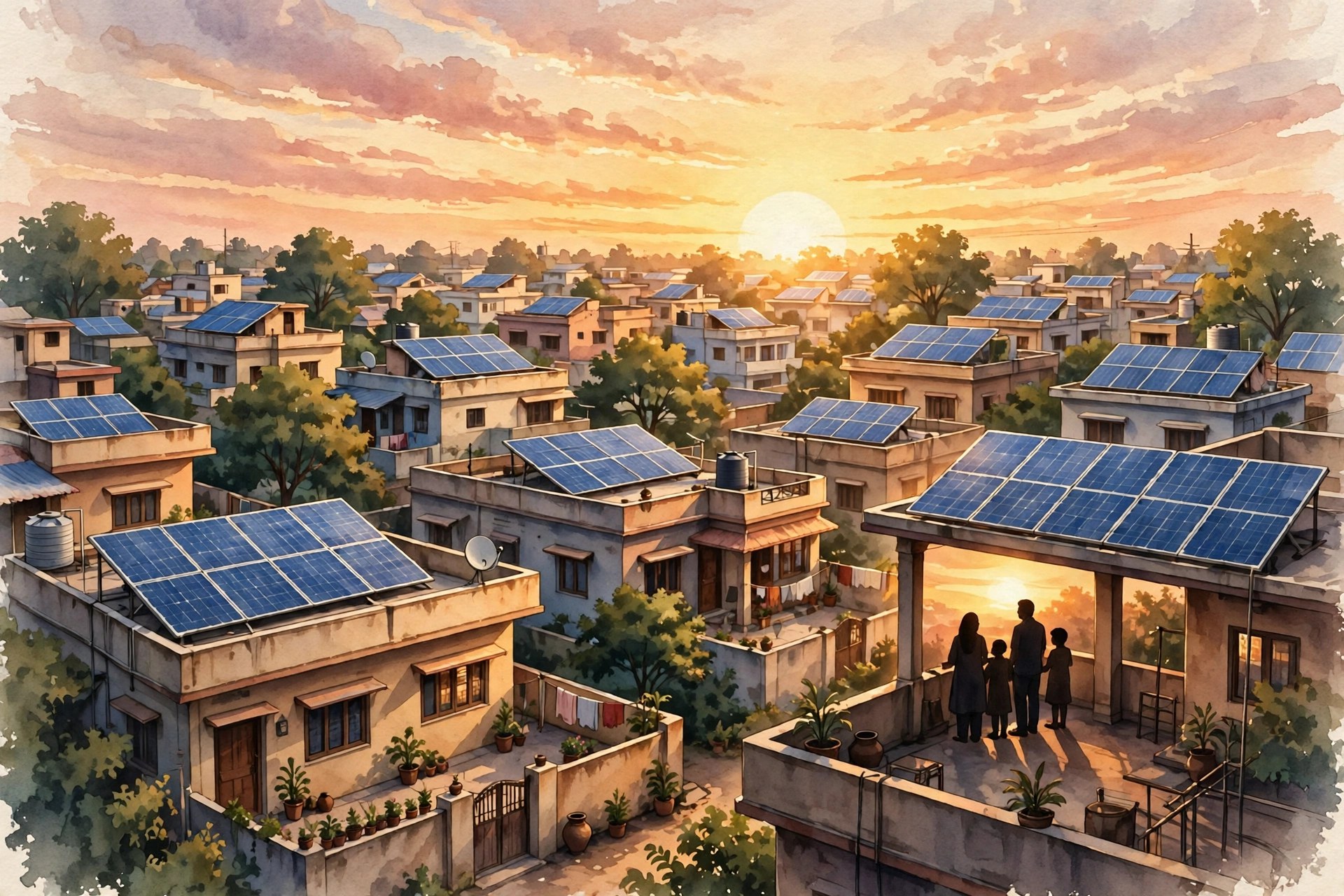
The household end of the transition is the PM Surya Ghar rooftop solar scheme. More than 21 lakh of the 65 lakh households covered by the scheme have received zero electricity bills in at least one billing cycle, Union Minister for New and Renewable Energy Pralhad Joshi said, adding that solar power that cost about Rs 8 per unit in 2014-15 is now available for as low as Rs 2.15 per unit Moneycontrol reported on 2 November. Akashvani News carried the same figures from Joshi’s article on 2 November, and Modi told the summit that over one lakh new rooftop installations are being added every six days Business Today reported. Joshi also noted that India is the only G20 country to have achieved the 50% non-fossil capacity target five years early — a claim the article records as the minister’s, consistent with Modi’s announcement but not independently audited here.
The other side of the ledger: coal output also jumped
India’s energy story is additive, not substitutive — total capacity of 558.89 GW means fossil generation is still growing in absolute terms even as its share falls. The same day as the summit, the Ministry of Coal said production from captive and commercial mines rose about 42% year-on-year to 22.03 million tonnes in October 2026, from 15.49 MT a year earlier, with dispatches up about 36% to 21.11 MT Business Standard reported on 2 November, citing the Ministry of Coal. April–October production from these mines reached 117.23 MT, up 11.3%, and the Lohari mine in Jharkhand received its opening permission in October, taking operational captive and commercial mines to 87 Business Standard reported. The ministry attributed the growth to “improved operational efficiency, higher mining productivity and better utilisation of capacity” across the sector, as reported by ANI. Holding both facts at once is the honest picture: the non-fossil share target was met early, and coal output set records in the same month. That tension is the regional story too — from the Lancet Countdown’s climate-health warning for Pakistan to Delhi’s GRAP vehicle restrictions that began on 1 November, South Asia is expanding energy supply and fighting its air and climate costs at the same time.
What to watch next
Three checks will show whether the new 500 GW ambition is a plan or a slogan. First, the annual addition rate: going from roughly 308 GW of non-fossil capacity to the 2030 goal, and then adding another 500 GW in the following decade, requires sustained record installations plus the transmission build-out Modi tied to Green Energy Corridors. Second, storage — round-the-clock supply is what turns capacity share into fossil displacement, and it is where the prime minister pointed startups and IITs at the summit, urging all-weather household solar models. Third, whether the fossil share of actual generation, not just installed capacity, keeps falling while coal output rises. The verified milestone stands on its own: the 50% non-fossil capacity pledge for 2030 was met in 2025. What India does with the head start is the story of the next five years.