Eight Labourers Electrocuted in Rajasthan’s Jhunjhunu as Road Mixer Touches 11,000-Volt Line; CM Orders Inquiry
Eight labourers died and five were injured in Chhapoli village, Jhunjhunu, when a cement mixer touched an 11,000-volt overhead line during community road work. CM orders inquiry; PM announces ex-gratia.

Eight labourers were killed and five others injured in Jhunjhunu district on Monday when the cement mixer they were moving touched an overhead high-tension power line — on a village road that local people were building themselves, with their own money, because the existing road had fallen apart.
Highlights
- What happened: a cement/gravel mixer being shifted during road work in Chhapoli village touched an overhead 11,000-volt line on Monday morning; current passed through the machine.
- Toll: 8 labourers dead, 5 injured (three women and two men) with burn injuries, under treatment at Udaipurwati hospital.
- The road: a narrow link from Chhapoli to Kadamkund, being built by villagers with public participation after the old road fell into disrepair.
- Response: Chief Minister Bhajan Lal Sharma ordered a high-level inquiry; PM Modi announced Rs 2 lakh from PMNRF for each deceased worker’s family and Rs 50,000 for each injured worker.
How the accident happened
Eight labourers were electrocuted when a machine being used during road construction came into contact with an electricity line in Rajasthan’s Jhunjhunu district on Monday, police said, adding that five others sustained burn injuries NDTV reported on 2 November. The accident occurred in Chhapoli village, under the Udaipurwati police station area, where a narrow road connecting Chhapoli to Kadamkund was being constructed with public participation. Udaipurwati SHO Rampal said the machine being used to mix gravel came into contact with an overhead power line:
“The machine came into contact with the high-tension line, causing electric current to pass through it. The labourers working there were electrocuted.”
The incident happened around 10 am as labourers were shifting the cement mixer to another location and its hydraulic jack — an iron pipe fitted on top of the machine in some accounts — touched the live overhead line, an 11,000-volt line The Indian Express reported on 2 November. Jhunjhunu Collector Arun Garg said the villagers had started building the road to the Kadam Kund temple themselves because the existing road was in a dilapidated condition, arranging financial assistance at their own level according to The Indian Express. One injured labourer, Gidaram Saini, told the media:
“We were working in Chapoli. We were in the process of pushing the machine to another location when it came in contact with the power line, resulting in the accident.”
The eight who died, and the five in hospital
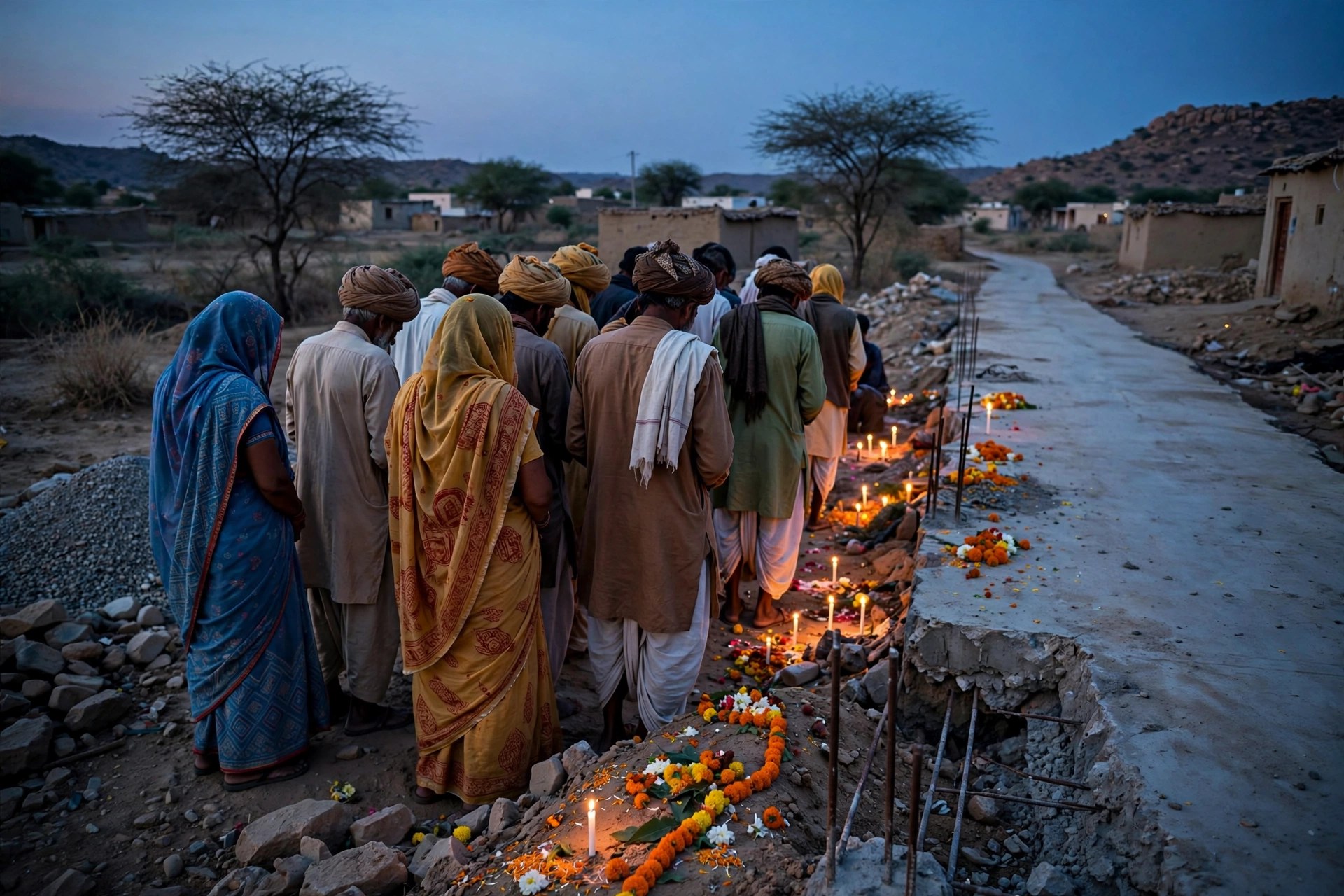
The deceased were identified as Hariram Gurjar (30), Mangalchand Gurjar (22), Kaluram Gurjar (29) and Pavan Gurjar (23), all residents of Haleda Mandawara village, and Vishnu Saini (38) — who was also the contractor — Surendra alias Suresh Saini (30), Mukesh Saini (27) and Fatehchand Saini (32), all residents of Chhapoli The Indian Express reported. One wire report carried Kaluram’s age as 20; the police identification carried by The Indian Express and The Statesman gives 29, and this report follows that. The injured — Geeta (45), Santra (35), Manju (38), Mahendra (27) and Gigaram (48), all of Chhapoli — were admitted to Udaipurwati hospital for treatment The Statesman reported on 2 November. All eight who died were local residents The Daily Pioneer reported.
Inquiry ordered, compensation announced
Chief Minister Bhajan Lal Sharma expressed grief and ordered a high-level inquiry, seeking a detailed report from the district collector and directing officials to ensure prompt treatment of the injured The Daily Pioneer reported. Energy Minister Heeralal Nagar said preliminary information suggested the work was being carried out privately, on a small scale, with public participation, and that technical officials had been told to ascertain the circumstances according to The Daily Pioneer. Prime Minister Narendra Modi condoled the deaths and announced an ex-gratia from the Prime Minister’s National Relief Fund, as the PMO posted:
“An ex-gratia of Rs. 2 lakh from PMNRF would be given to the next of kin of each of those who lost their lives. The injured would be given Rs. 50,000.”
The Statesman reported the PMO announcement on 2 November. Minister Jhabar Singh Kharra, who visited the site, confirmed the road was being constructed by villagers on a community basis when the mixer touched the 11,000-volt line according to The Statesman, citing ANI.

The question the inquiry has to answer
The facts already on record frame the inquiry’s real subject. This was not a tendered highway project with a safety officer and a line-clearance certificate; it was villagers rebuilding their own broken road with a hired mixer, under a live 11 kV line, with no authority apparently having checked the machine’s height against the wire before work began. India’s infrastructure arguments usually run through big projects — the corridor progress in the Bharat Bullet Train corridor update sits at one end of that spectrum — but most rural road work in India looks like Chhapoli: small, informal and uninspected. And the state’s own workforce tragedies keep rhyming with the risks tracked in the Lancet Countdown 2026 warning on climate and health risks: outdoor labourers absorb the danger first. Whether anyone was responsible for clearing that line — and what changes for community-built roads after this — is what Sharma’s inquiry will have to establish.