INDIA Bloc’s ‘Chalo Delhi’ Rally at Ramlila Maidan: CEC Resignation Demand Takes the Fight to the Streets
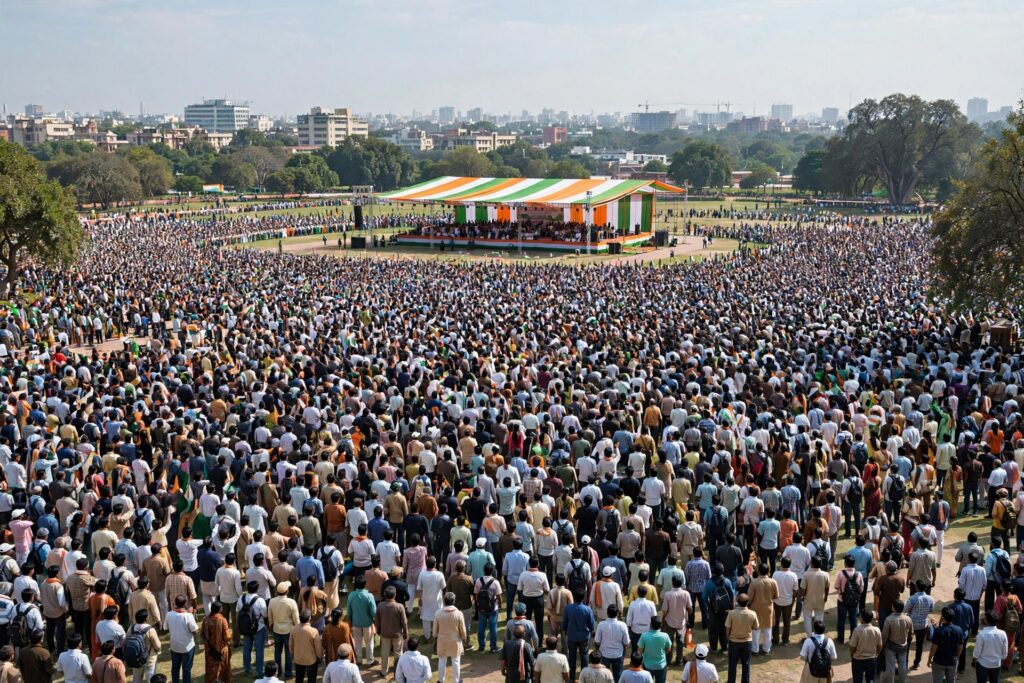
The INDIA bloc's 'Chalo Dilli' march filled Delhi's Ramlila Maidan on November 1, 2026, demanding Chief Election Commissioner Gyanesh Kumar's resignation over alleged voter deletions in the SIR electoral roll revision — with the BJP hitting back the same day.
Highlights
- The INDIA bloc held its ‘Chalo Dilli’ march and mega rally at Delhi’s Ramlila Maidan on Sunday, November 1, 2026, demanding the immediate resignation of Chief Election Commissioner Gyanesh Kumar.
- The opposition alleges large-scale voter deletions during the Special Intensive Revision (SIR) of electoral rolls and wants EVMs replaced with paper ballots — claims the Election Commission and the government dispute, saying the revision removes duplicate and ineligible entries.
- Leaders including Rahul Gandhi, Sonia Gandhi, Mallikarjun Kharge, Mamata Banerjee and Akhilesh Yadav marched from the Minto Road–Connaught Place junction to Ramlila Maidan, a route of nearly 1.5 kilometres.
- More than 4,000 police personnel were deployed, with 200 CCTV cameras, drones and body-worn cameras in use; the bloc said it expected up to 10 lakh people while Delhi Police expected around 50,000.
- The BJP hit back the same day, calling the rally a “flop” and staging its own march in West Delhi to mark the anniversary of the 1984 anti-Sikh riots.
What happened
On Sunday, November 1, 2026, the Indian National Developmental Inclusive Alliance (INDIA) bloc staged its ‘Chalo Dilli’ march to Delhi’s Ramlila Maidan, demanding the immediate resignation of Chief Election Commissioner (CEC) Gyanesh Kumar. The Hindu’s preview of the rally records that the bloc’s central demand was Kumar’s resignation over what it calls severe irregularities in the electoral rolls.
The day began with INDIA bloc MPs assembling at the Constitution Club at 11 a.m., before the march moved at noon from the Minto Road–Connaught Place junction towards Ramlila Maidan, a nearly 1.5-kilometre route, according to The Hindu. Senior leaders taking part included Rahul Gandhi, Sonia Gandhi, Mallikarjun Kharge, Mamata Banerjee, Abhishek Banerjee, Hemant Soren, Revanth Reddy, Tejashwi Yadav and Akhilesh Yadav.
The rally had been announced by Congress leader K.C. Venugopal on October 5, and it followed a symbolic “public impeachment” exercise the opposition held on October 31 at Kharge’s residence, where six charges were presented against the CEC — including, as The Hindu reports, conspiring with the ruling BJP to steal elections, deleting 13.2 crore voters through the SIR, and acting at the behest of Prime Minister Narendra Modi and Home Minister Amit Shah. Those are the opposition’s charges, not findings by any court or inquiry.
The core dispute: what is the SIR, and why does it matter?
The Special Intensive Revision is a door-to-door re-verification of electoral rolls. The opposition says it has been used to delete legitimate voters, particularly from marginalised, backward and minority communities, as Mathrubhumi English reported on the day of the rally. The Election Commission and the government have maintained, as India TV’s live coverage notes, that the revision is intended to remove duplicate and ineligible entries.
That framing gap is the whole story. For the opposition, a name missing from the roll is a citizen stripped of a vote. For the Commission, a name removed is a duplicate or an ineligible entry cleaned up. Both sides cite the same revision exercise and reach opposite conclusions — which is why this fight is unlikely to be settled by one rally, and why it will probably return to Parliament, the courts and the next state elections.
What the leaders said — in their own words
Congress leader Rahul Gandhi used the rally stage to make his strongest claim yet about the scale of deletions. Addressing the gathering, he said:
“Fifteen per cent of India’s voters were removed from the voter list after the 2024 elections. This means the 2024 election was an illegal election. It was a stolen election. I am not the one saying this, the Election Commission is saying this.”
He went further, alleging that vote theft had taken place in several states and the 2024 Lok Sabha elections:
“Votes have been stolen through EVMs and by deleting and adding names to voter lists.”
And in a separate remark at the rally, he put a number on the deletions:
“Names of 13.5 crore voters have been deleted.”
Note the number shifting between the opposition’s own statements: the October 31 impeachment resolution cited 13.2 crore deletions, while Gandhi’s rally speech cited 13.5 crore. Neither figure has been independently confirmed, and readers should treat both as opposition claims rather than verified totals.
Congress president Mallikarjun Kharge framed the rally as a fight for democracy itself, saying:
“We must remove these thieves. Only if Modi goes will democracy survive. We must remove Modi to save democracy.”
Congress leader Bhupinder Singh Hooda tied the size of the gathering directly to the demand, saying:
“We have never seen such a huge rally in the national capital before; CEC Gyanesh Kumar has to resign.”
And Congress MP Shashi Tharoor, participating in the rally, said:
“People have lost faith in Chief Election Commissioner Gyanesh Kumar… We don’t want this gentleman as a non-impartial empire trying to determine the political future of India by cutting 130 million names from the electoral rolls. You have to give people the right to vote…”
The march, the security and the city around it
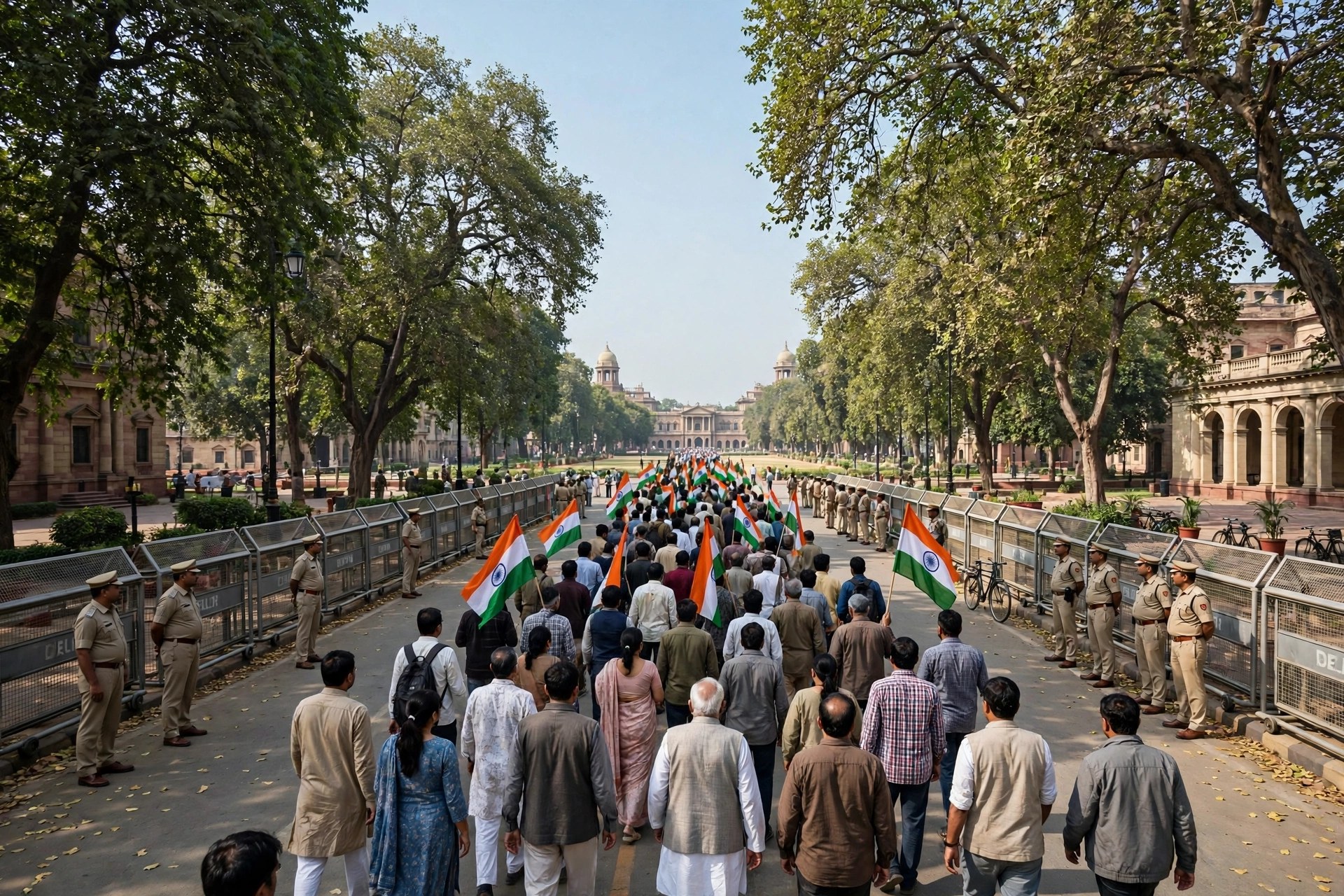
The mobilisation was one of the most heavily policed political events in the capital in recent memory. More than 4,000 police personnel, along with Central Armed Police Force companies, were deployed along the march route and at the venue, with the ground divided into 14 zones, each supervised by an officer of assistant commissioner rank. More than 200 CCTV cameras, drones and body-worn cameras were used for surveillance, The Hindu reported.
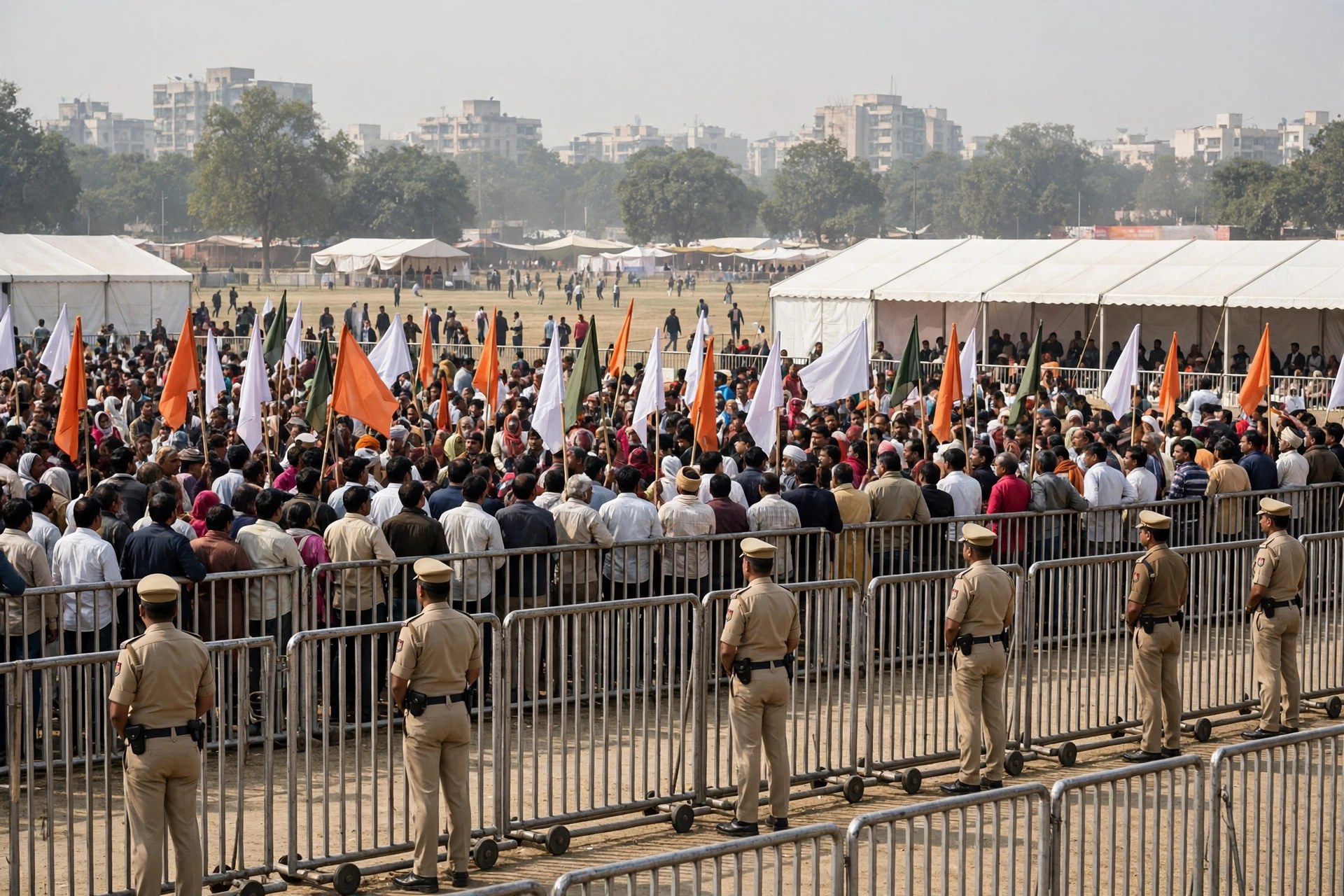
The numbers game around turnout is itself part of the politics. The INDIA bloc said it expected a turnout of up to 10 lakh people, while Delhi Police expected around 50,000, The Times of India reported. Ramlila Maidan can hold 45,000 to 50,000 people when empty, but its capacity falls to an estimated 30,000–40,000 once chairs, enclosures and passageways are in place. No final official attendance figure was available in the sources checked for this article, so any claim about the actual crowd size should be treated with caution.
Traffic in central Delhi was heavily restricted between 10 a.m. and 5 p.m., with diversions at points including Netaji Subhash Marg, Rajghat, Delhi Gate, ITO, Ajmeri Gate and Jhandewalan. Delhi was already a city under strain that weekend: separate vehicle restrictions under the Graded Response Action Plan were also in force in the capital from November 1.
Why Ramlila Maidan matters
Ramlila Maidan is not a random venue. It is Delhi’s historic protest ground — the stage of mass movements from the anti-corruption agitation of 2011 to countless rallies since. Choosing it was a deliberate signal: the opposition wanted this to look like a people’s movement, not a press conference. The tricolour canopy over the main stage, the second stage for state units, the rows of white tents and the barricaded zones all followed the familiar template of a show-of-strength rally.
But symbolism cuts both ways. A rally at Ramlila Maidan invites comparison with the great gatherings of the past, and the BJP’s response on the day made exactly that kind of comparison — unfavourably.
Public reactions: the BJP hits back
The BJP’s response was swift and sharp, and it came from several directions at once. BJP leader Shahnawaz Hussain dismissed the event outright:
“The INDIA alliance’s rally turned out to be a complete flop… Nothing will come of doing this, the public knows everything that these people are against constitutional institutions, they are against the Supreme Court, they are against the Election Commission. When they win, the EVM becomes good, SIR becomes good, and if they lose, they blame the entire defeat on the Election Commission…”
BJP MP Sambit Patra accused Rahul Gandhi of insensitivity for holding the rally on November 1, the anniversary of the 1984 anti-Sikh violence, claiming around 5,000 Sikhs were killed and saying survivors had appealed to Gandhi to postpone the rally but he refused, India TV reported.
Union Minister JP Nadda said the rally’s objective was to paralyse Delhi during the festive season, according to India TV:
“The objective of Rahul Gandhi and the Congress party is to paralyse Delhi during this sacred festive season, to strike a blow at the livelihoods of our small-scale shopkeepers and traders, and to incite an atmosphere of unrest and chaos in the country.”
And Union Home Minister Amit Shah, speaking in Chandigarh, warned the opposition about its tactics, India TV reported:
“Lying, spreading chaos, propagating negativity, obstructing the functioning of Parliament, and taking parliamentary issues to the streets to create a ruckus—if this has been your nature, then get ready to spend another five years in the opposition.”
The BJP also staged its own march in West Delhi, from Hari Nagar Bus Depot to Tilak Nagar Metro Station, to commemorate the victims of the 1984 anti-Sikh riots — a counter-programme running in parallel with the opposition rally. Congress leader Salman Khurshid, meanwhile, promised the campaign would not end with one rally: “Our protest will not stop with just one rally. Our movement will continue. Just wait and see what happens next.”
What happens next
Three things are worth watching. First, whether the opposition converts the rally’s energy into a concrete parliamentary or legal step — a privilege motion, a court petition, or a coordinated state-level campaign. Second, whether the Election Commission responds publicly to the specific deletion figures cited at the rally, rather than to the general charge. Third, whether the “vote chori” campaign becomes the opposition’s main plank in upcoming state elections — Akhilesh Yadav already used the rally stage to predict the BJP’s defeat in the 2027 Uttar Pradesh polls, calling Ramlila Maidan the “Haldighati of democracy,” India TV reported.
The fight over voter rolls is not unique to India. In the United States, with the 2026 midterms days away, early voting and polling are already shaping a contested election season. The difference is that in India the argument is about the roll itself — who is on it, who has been taken off it, and who gets to decide. Meanwhile, India’s policy arena moves on a quieter track: India is holding talks as a Scotch whisky tariff dispute widens, a reminder that politics and trade run side by side.
What is certain is that the SIR row has moved from committee rooms to the streets of the capital. What is not certain — and what neither side’s speeches can settle — is how many voters were actually, wrongly removed. Until the Election Commission publishes verifiable, booth-level data that independent analysts can check, the numbers will remain claims, and the rallies will keep coming.