Samsung Super Fast Charging vs iPhone Fast Charging vs Pixel Charging Compared
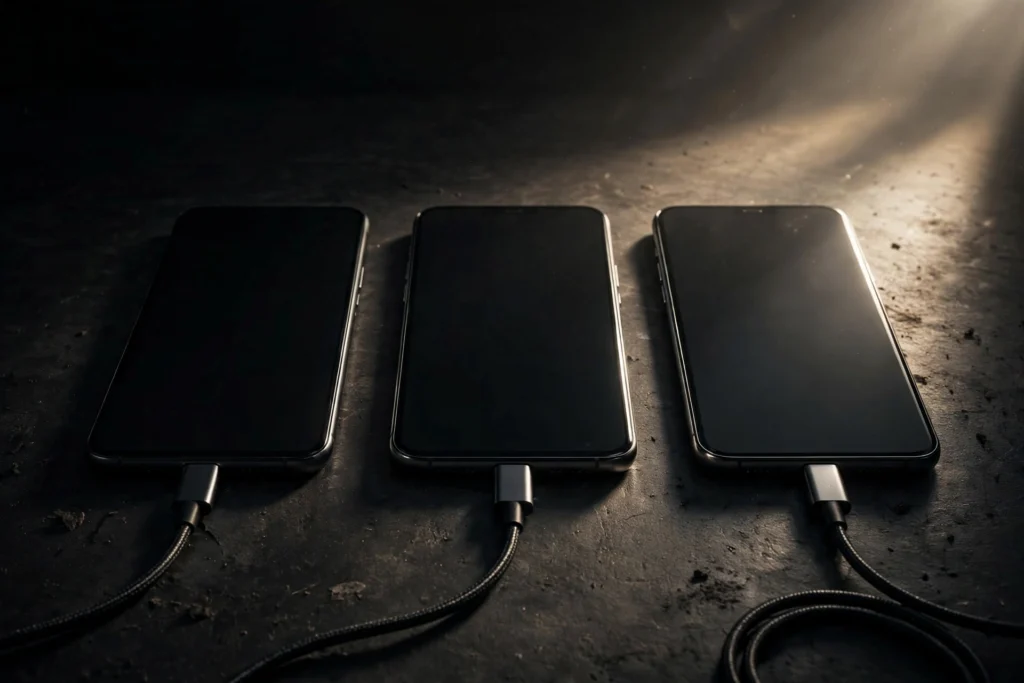
Three brands, one USB-C socket, three different names for fast charging — this guide untangles what Samsung, Apple and Google actually require.
Key points
- All three brands use USB-C and USB PD, but Samsung’s Super Fast Charging tiers rely on PPS, while iPhone uses standard USB PD with no PPS requirement.
- Your exact model sets the ceiling: Galaxy S25 is limited to 25W, S25+ and S25 Ultra reach 45W, and S26 Ultra reaches 60W.
- The cable can cap your speed — Samsung’s 45W tier needs a 5A cable, so the adapter alone is not enough.
If a drawer of chargers leaves you wondering why one phone charges quickly and another slowly, you are not alone. The foundations have converged; the labels and small print have not. Our pillar guide to USB-C fast charging explained covers watts, PD and PPS in depth; here we compare the three brands directly.
All three brands now use USB-C and USB PD, so the basics finally match
One connector and one core standard are shared — the differences sit in the details.
Samsung, Apple and Google all charge over USB-C and all use USB Power Delivery (PD). That shared base means a good USB-C PD charger is no longer tied to one brand — yet the same words, fast charging, cover quite different adapter, cable and model requirements.
Two shared rules matter. First, the phone decides how much power to take, so a bigger adapter does not force extra power into a phone that cannot use it. Second, the cable can cap speed: a standard cable is limited to 60W at most, and some tiers need a specific higher-rated cable.
Samsung splits fast charging into clear tiers, and your exact Galaxy model decides the ceiling
From 15W to 60W, the tier name tells you the requirement.
Samsung’s ladder starts with Adaptive Fast Charging at 15W over USB-A. Super Fast Charging at 25W uses USB-C PD with PPS and is standard for many Galaxy S, A and Z devices. Super Fast Charging 2.0 at 45W requires a compatible USB-C cable — specifically a 5A cable — with a 45W adapter. Miss the cable requirement and the headline speed will not arrive.
At the top sits Super Fast Charging 3.0 at 60W, Samsung’s USB-C PD 3.1 PPS charger, the EP-T6010. It is backwards compatible, so earlier devices charge at their own maximum. That matters, because not every Galaxy supports the higher tiers: Samsung’s table lists the Galaxy S25 at 25W only, the S25+ and S25 Ultra at 45W, and the S26 Ultra at the 60W tier. Check your exact model first, as our guide on how to choose a fast charger for your phone recommends.
Apple keeps iPhone fast charging simpler, with standard USB PD and no PPS requirement
An 18W or greater USB-C adapter unlocks fast charging on iPhone 15 or later.
Apple’s approach is refreshingly plain. For iPhone 15 or later, Apple says you can fast charge with an Apple 18W or greater USB-C adapter, or a comparable third-party adapter that supports USB PD. iPhones use standard USB PD, with no PPS requirement — the easiest of the three systems to shop for.
Apple expresses the newest models in time: iPhone 17, 17 Pro and 17 Pro Max reach up to 50% in around 20 minutes with a 40W adapter or higher. The iPhone 17e and iPhone Air need 20W or higher and reach up to 50% in around 30 minutes. One caveat from Apple: fast charging may not work when the phone is too hot or too cold.
Google gives Pixel owners flexible adapter choices, but the cable and accessories still decide the result
Google lists its own chargers alongside PPS and other USB PD options.
Google is the most permissive on adapters. Its support page lists the Google 30W, 45W or 67W USB-C charger, or any PPS adapter rated 30W or more, or other USB PD adapters rated 15W or more. Pixel owners have a genuine choice, although the adapter picked can still affect speed.
Google says the Pixel 9 Pro XL and Pixel 10 series can charge up to 30W or more, and tells owners to check exact model specifications. USB-A to USB-C charging is slower than USB-C to USB-C. A “Check charging accessory” notification means, Google says, the cable or adapter may be unsupported or damaged, causing very slow or no charging. Our guide on why your phone is charging slowly covers the same checks.
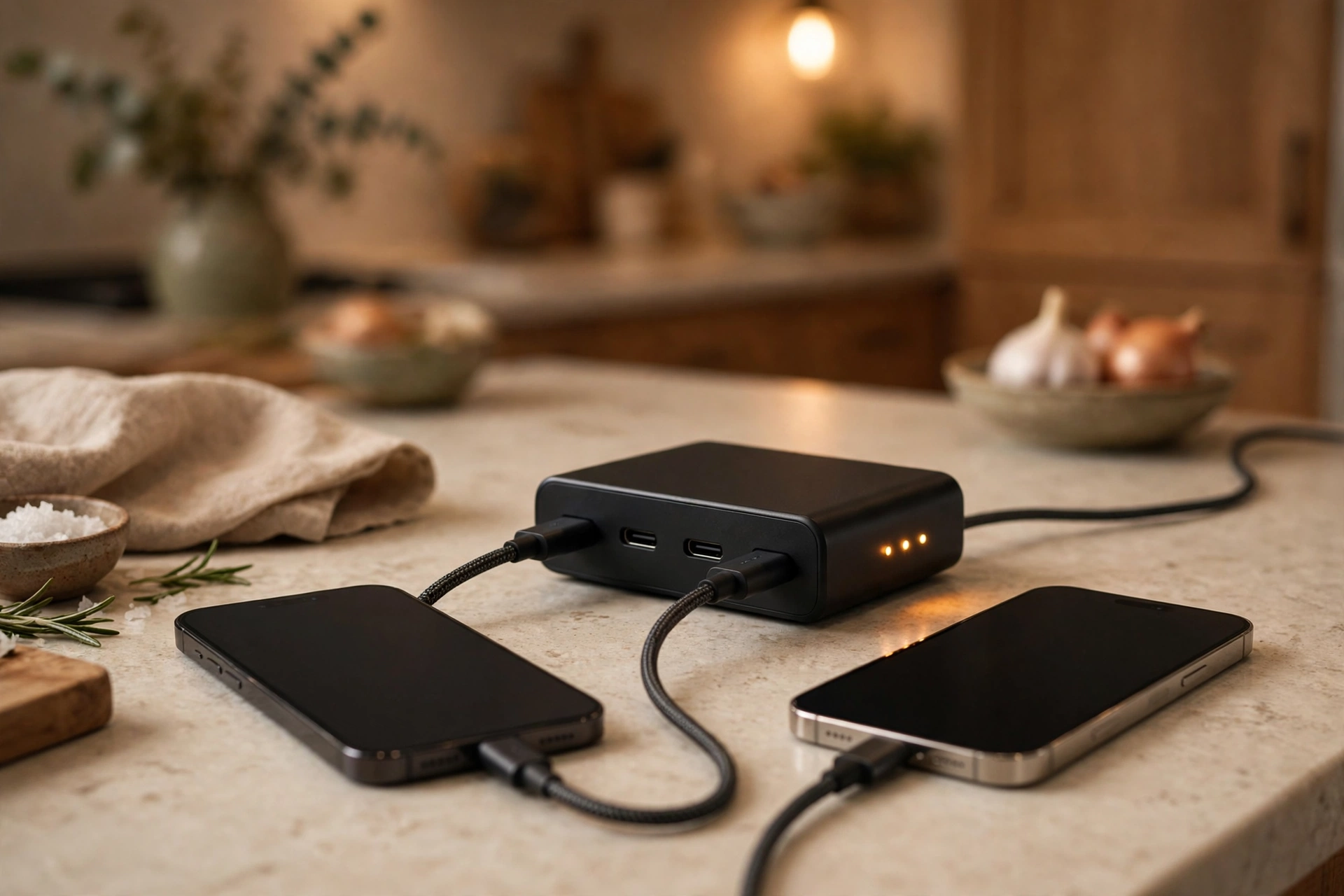
Side by side, the right cable matters just as much as the right charger
The table compares top tier, standard, and adapter and cable guidance.
| Brand | Top wired tier | Standard needed (PPS?) | Adapter guidance | Cable note |
|---|---|---|---|---|
| Samsung | 60W Super Fast Charging 3.0 (model-dependent; S26 Ultra) | USB-C PD with PPS | 25W for Super Fast Charging; 45W adapter for the 45W tier; EP-T6010 for 60W | 5A cable required for the 45W tier |
| Apple | Fast charge (iPhone 15 or later); iPhone 17 up to 50% in around 20 minutes with 40W+ | USB PD — no PPS requirement | 18W or greater USB-C adapter, or comparable third-party USB PD adapter | Temperature can affect fast charging |
| Pixel 9 Pro XL and Pixel 10 series can charge up to 30W or more (check exact model) | USB PD; PPS adapter rated 30W or more is one listed option | Google 30W, 45W or 67W USB-C charger, or other USB PD adapters rated 15W or more | USB-C to USB-C is faster than USB-A to USB-C |
A pattern appears: Samsung offers the highest named tiers but asks the most of adapter, cable and model check. Apple is simplest. Google sits in between.
What this means
One good PPS-capable USB-C PD charger and the right cable solve most mixed-brand problems.
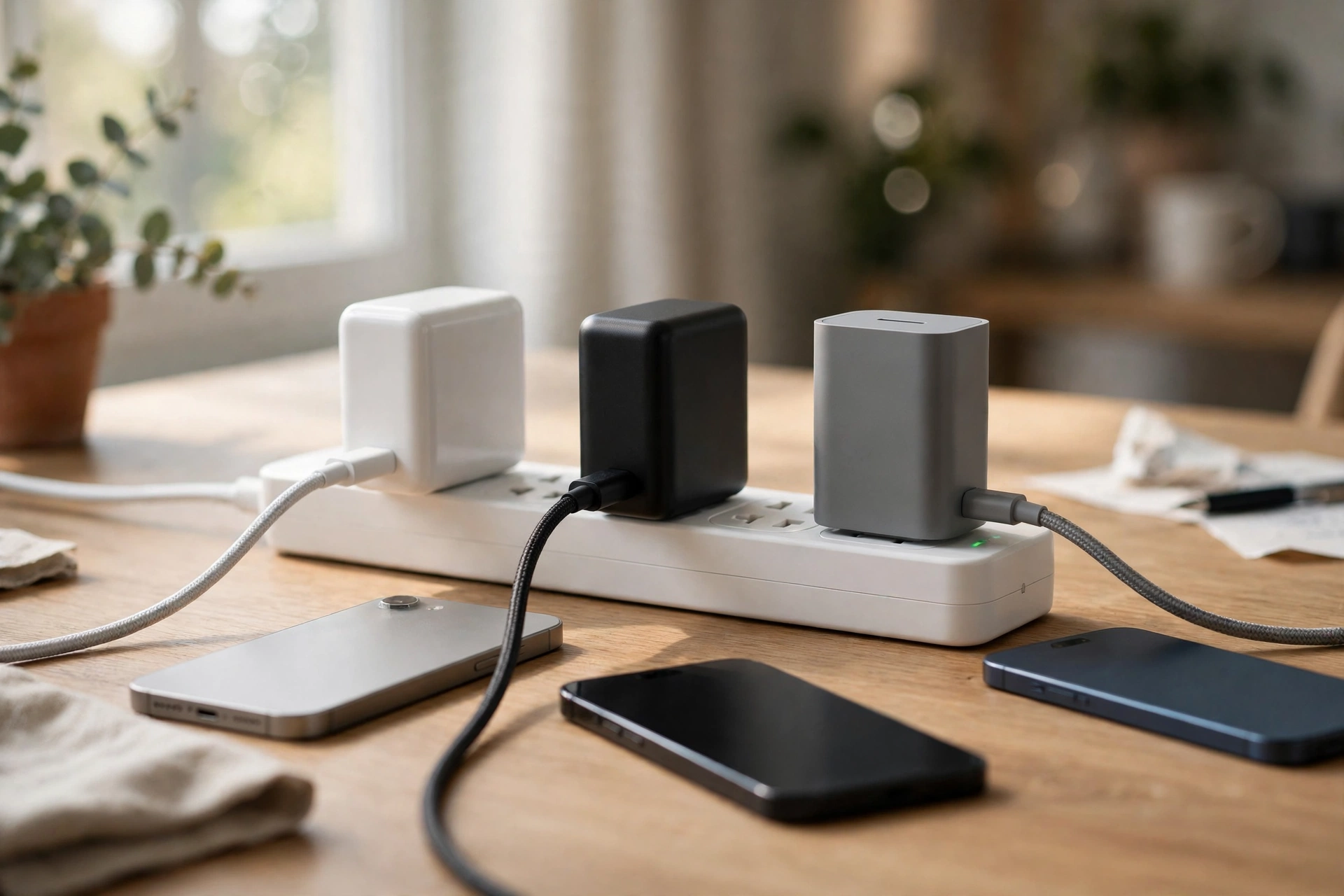
Picture a fairly ordinary household, because this is where the confusion actually bites. One person has a Galaxy, another has an iPhone, and a third has a Pixel, and by the evening all three phones are hunting for charge at the same kitchen counter. Three boxes, three sets of small print, and one shared frustration: whichever charger is free never seems to be the fast one. That feeling is understandable — the industry created it by giving the same basic idea three different names and three different sets of conditions.
Here is the reassuring part. Because all three brands build on USB-C and USB PD, you do not need to start again for each phone. In our view, the sensible centre of a mixed household is one good USB-C PD charger that also supports PPS, paired with a proper USB-C to USB-C cable — and, if a Galaxy in the house supports the 45W tier, a 5A cable for that phone. That setup respects Samsung’s PPS requirement, fits Apple’s standard PD approach, and matches the options Google lists for Pixel. Each phone will take only the power it is designed to take, exactly as the system is meant to work.
Think about travel, too. Packing three chargers grows teeth at the airport, when one bag is overweight and someone’s phone is on 9%. One shared charger for all three brands, plus the right cables, is lighter and far less likely to be left behind in a hotel room. A multi-port version also ends the kitchen-counter queue overnight.
Our honest advice is to check the model before the marketing. Look up what your exact Galaxy supports before paying for a 45W or 60W tier it may never use. Check which iPhone you have before assuming Apple’s fastest quoted result applies to it. Check your Pixel model’s specifications rather than relying on the word Pixel alone. And if charging is suddenly slow, suspect the cable and the temperature before blaming the phone. Spend once, on the shared standard done properly, and the nightly charger argument quietly ends. That, more than any headline watt number, is what fast charging is supposed to buy you: time back, with less faff.
Bottom line
Buy for the shared standard first, then check your model’s ceiling and cable.
In our view, Samsung is the most demanding but offers the highest named tiers, Apple is the simplest to buy for, and Google is the most flexible on adapters. For a mixed-brand home, a USB-C PD charger with PPS, the correct cable for any 45W Galaxy, and a quick model check will serve all three well.
Related Guides
Go deeper on watts, choosing a charger, and slow charging fixes.
Read Next:
- USB-C Fast Charging Explained: Watts, PD and PPS
- How to Choose a Fast Charger for Your Phone
- Why Is My Phone Charging Slowly? Causes and Fixes
Sources
Primary Samsung, Apple and Google support pages, accessed 9 November 2026.