
Highlights
- ISRO chairman V. Narayanan said India will expand its space operations significantly with four functional launch pads by 2029, speaking at a graduation ceremony at a private university on Saturday, October 24, 2026
- The roadmap includes a 2,000-acre dedicated Small Satellite Launch Vehicle (SSLV) complex at Kulasekarapattinam in Tuticorin district, Tamil Nadu, to meet global demand for satellite deployment
- Narayanan clarified ISRO will not be privatised, but said partnering with private firms is essential, with ISRO handholding startups and transferring technological expertise
- ISRO plans its first uncrewed Gaganyaan test within the next two months, followed by two more uncrewed tests before the crewed mission, after approximately 8,000 ground-based experiments
The announcement: four pads by 2029
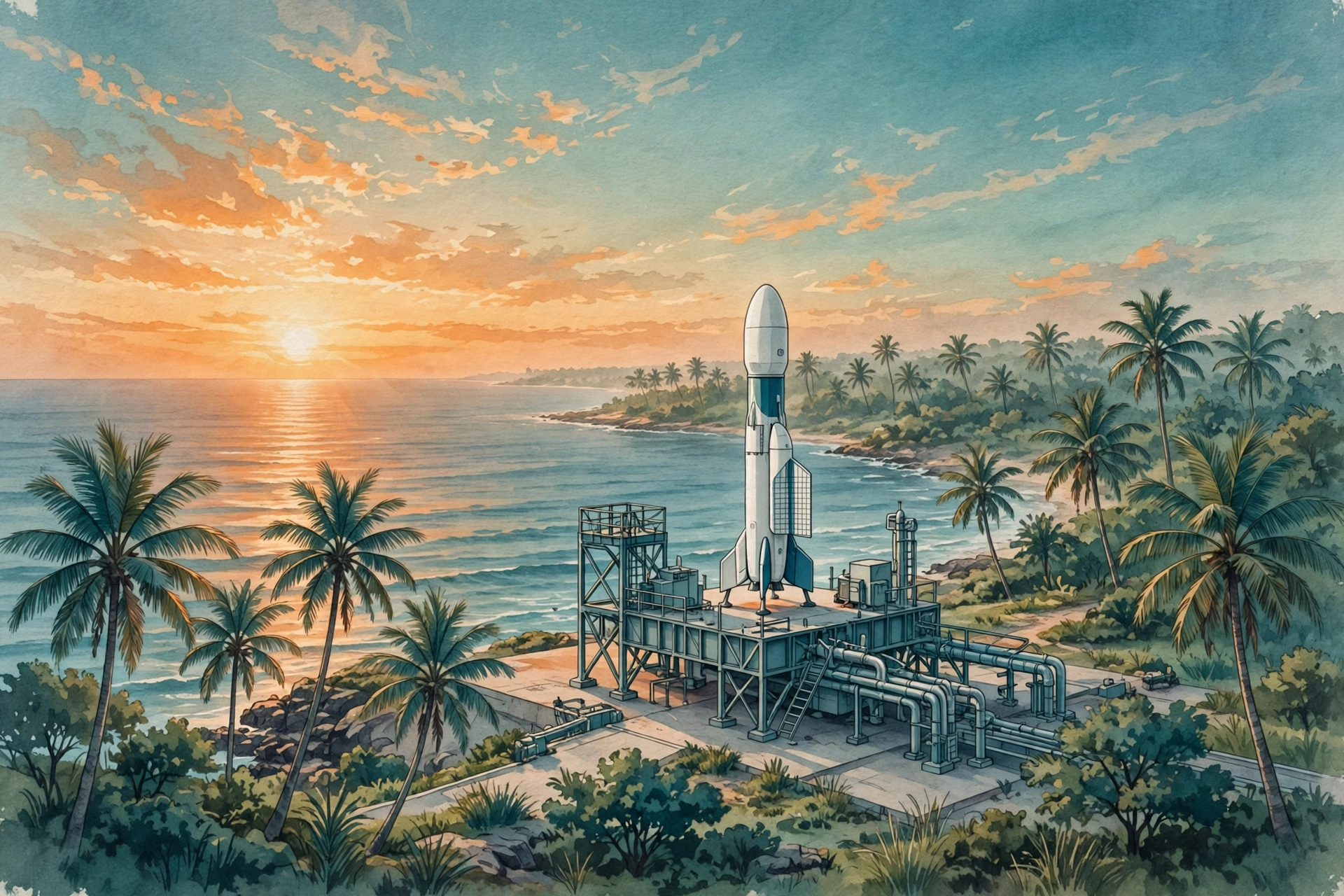
ISRO chairman V. Narayanan has said that India will expand its space operations significantly with four functional launch pads by 2029 (The Hindu). He outlined the roadmap while speaking at a graduation ceremony at a private university on Saturday, October 24, 2026 (The Hindu). In his own words: “India will expand its space operations significantly with four functional launch pads by 2029, supported by an increasing reliance on private industry partnerships to handle commercial operations” (The Hindu).
One honest gap in the announcement should be stated upfront: Narayanan did not specify the locations or timelines for each of the four pads individually (Daily Pioneer). What follows is therefore the verified context around the headline — what exists today, and which projects are already on the record — rather than a breakdown the chairman himself provided.
Where India launches from today: one spaceport, two pads
At present India has only one spaceport, the Satish Dhawan Space Centre at Sriharikota, and it has two launch pads (The Hindu). The first launch pad was built in the early 1990s, and the second became operational in 2005 (The Hindu). A parliamentary standing committee has already flagged the risk in depending on so little infrastructure, noting that the Department of Space is developing the Kulasekarapattinam complex and a proposed third launch pad at Sriharikota, expected to become operational by 2029–30 (The Hindu).
That context makes the arithmetic of “four by 2029” plausible — the two existing Sriharikota pads, the proposed third Sriharikota pad, and the new Kulasekarapattinam complex — but it remains our reading of projects already in the public record, not a breakdown Narayanan spelled out on Saturday.
Kulasekarapattinam: the 2,000-acre SSLV complex
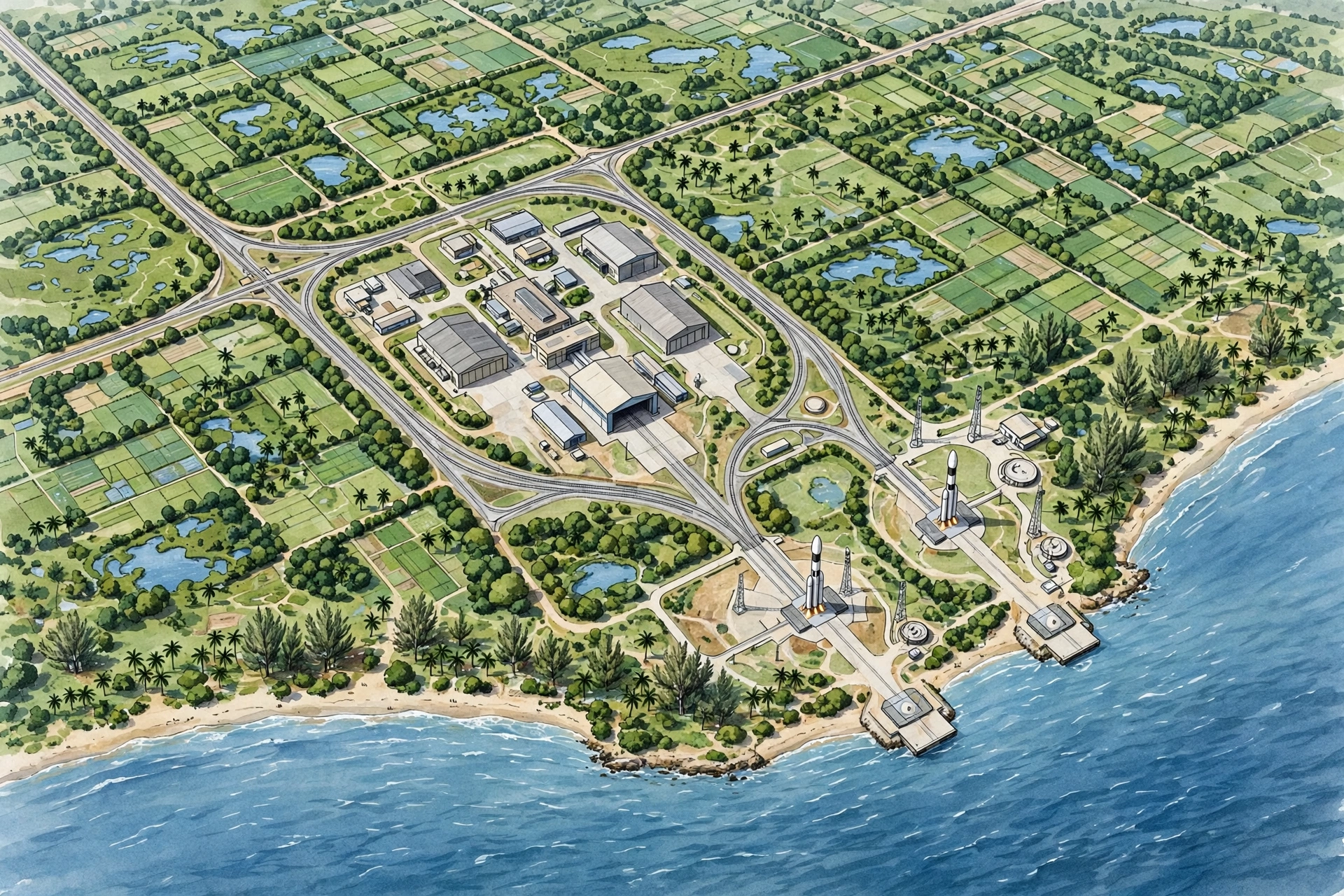
The centrepiece of the roadmap is in the south. Narayanan outlined a 2,000-acre dedicated Small Satellite Launch Vehicle (SSLV) complex at Kulasekarapattinam in Tuticorin district, to meet the global demand for satellite deployment (Business Standard). The upcoming facility will feature crucial infrastructure such as integration buildings, launch pads, rail-track systems, telemetry, tracking, and command systems (The Hindu). On acreage, reporting differs slightly by scope: Narayanan described a 2,000-acre dedicated SSLV complex, while earlier reporting on the wider spaceport put the second spaceport spread across approximately 2,233 acres (The Times of India) — figures we report as stated, since they appear to describe the complex and the full site respectively.
The complex is being built primarily for launches involving small rockets, and forms part of the new Kulasekarapattinam spaceport being developed by ISRO as India’s second launch site, located on the Tamil Nadu coast around 55 km from Thoothukudi (The Times of India). It has been designed to support a high launch cadence with faster turnaround between missions, complementing the SSLV itself, which was developed for on-demand launches of small satellites, requiring fewer personnel and shorter integration times than larger launch vehicles (The Times of India).
Why Kulasekarapattinam matters: the dogleg Sriharikota cannot avoid
Geography is the whole argument for this site. The Kulasekarapattinam site offers advantages for small satellite launches into polar and Sun-synchronous orbits: unlike launches from Sriharikota, rockets from Kulasekarapattinam can fly directly south over the Indian Ocean without having to execute a dog-leg manoeuvre to avoid flying over Sri Lanka, which improves payload capability, reduces fuel requirements and makes missions more efficient, particularly for the SSLV (The Times of India).
That detour is a rounding error for a heavy rocket and a serious tax for a small one. Every kilogram of fuel an SSLV burns bending around Sri Lanka is payload it cannot carry to a polar orbit — exactly the orbit Earth-observation and small-satellite customers most often want. A pad that deletes the detour does not just save fuel; it raises the saleable capacity of every small launch flown from it. This is also why the expansion story belongs in the same conversation as the commercial one reshaping the wider industry, from reported SpaceX–Tesla merger talks to India’s own private launch startups: launch capacity, not just rockets, is becoming the scarce asset.

Not privatisation — but private partners everywhere
Narayanan drew a clear line on ownership while opening the door on operations. Clarifying that the national space agency will not be privatised, he emphasised that partnering with private firms was essential to meet surging global and domestic demands for thousands of satellites (The Hindu). In his words: “To handle this expanding ecosystem, ISRO will handhold startups and private enterprises, transferring technological expertise to foster economic growth and generate thousands of high-tech jobs” (The Hindu).
The private role is already moving from policy to paperwork at the new site itself: space promoter-cum-regulator IN-SPACe has issued an expression of interest inviting proposals from eligible Indian entities to operate and manage the new launch complex at Kulasekarapattinam, with ISRO providing technical guidance, operational support, training and handholding for a defined period (The Times of India). The selected operator would be responsible for end-to-end management of the launch complex, including launch campaign operations, maintenance, safety and security, and mission readiness (The Times of India).
The other countdown: Gaganyaan and Chandrayaan-5
The infrastructure announcement came with programme updates. ISRO plans to conduct the first uncrewed Gaganyaan test within the next two months, followed by two subsequent uncrewed tests before the crewed mission (The Hindu). Explaining what those tests must prove, Narayanan said: “These tests will evaluate environmental control, safety systems, crew escape mechanisms, and module interiors under varying pressure, temperature, and humidity conditions” (The Hindu). ISRO has successfully conducted approximately 8,000 ground-based experiments for the mission, and four astronaut-designates are currently undergoing specialised training (Business Standard).
Looking further ahead, Narayanan revealed plans for Chandrayaan-5, a collaborative lunar mission with Japan’s space agency featuring a 350-kg rover designed to conduct 100 days of surface experiments (The Hindu).
What to watch
First, the breakdown.
The four-pad headline is on the record; the per-pad locations and commissioning dates are not, beyond the projects already public. The next detailed statement from the Department of Space is where that gap should close.
Second, the cadence test.
Kulasekarapattinam only changes India’s position if the high-cadence, fast-turnaround design survives contact with real operations — and if private operators actually take up the IN-SPACe route to run it.
Third, the sequencing.
An uncrewed Gaganyaan test inside two months, a third Sriharikota pad targeted around 2029–30, and a new spaceport rising in Tamil Nadu all compete for the same engineering attention. Narayanan’s roadmap treats them as one programme. The next two years will show whether India’s launch infrastructure can finally grow as fast as its ambitions.