

Highlights
- The October 15 Roadster demonstration really happened — livestreamed on Tesla’s X account, filmed by attendees, and rated authentic by fact-checkers at Snopes the next day
- The “flight” is measured in seconds: ten compressed-air thrusters, no driver on board, no sustained flight shown — and the FAA says the vehicle does not meet its definition of an aircraft
- You cannot buy the flying version: production is targeted for 2028, the full-flight “Rocket” variant is invitation-only and not approved for public roads, and final prices have not been disclosed
- Musk spent a decade publicly doubting flying cars — and the purpose-built flying car constantly linked to his name, Alef’s Model A, is not his company at all
What Tesla actually did on October 15
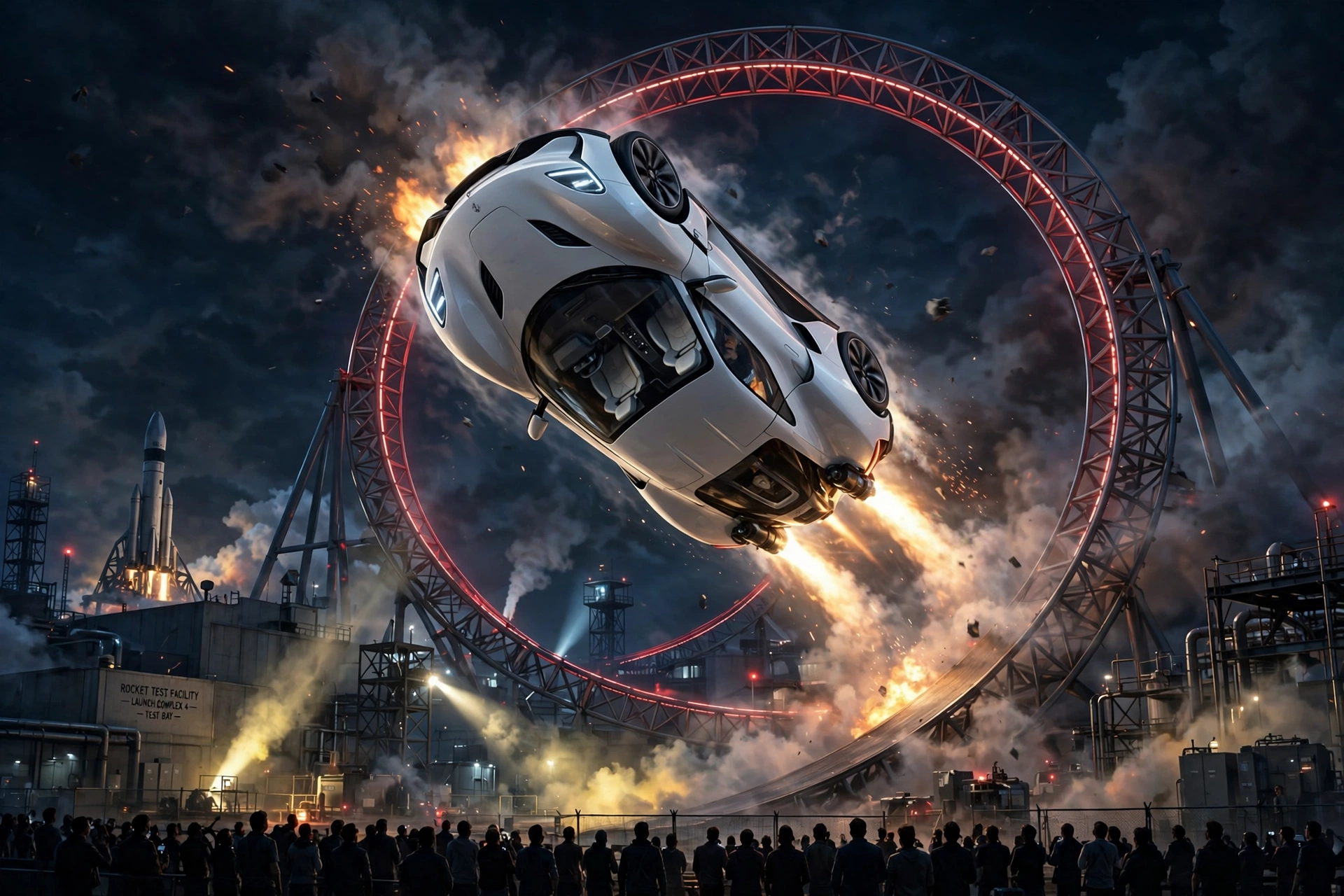
On Thursday, October 15, 2026, Tesla unveiled its next-generation Roadster at a SpaceX test facility in McGregor, Texas, in an event livestreamed on Tesla’s X account (AFP via Philstar). The prototype drove up a steep, curved ramp — holding itself nearly upside down with a fan-based suction system — launched into the air, performed a full barrel roll using cold-gas thrusters, and landed on its wheels; in a separate stunt it leapt over a row of parked Teslas, including a Cybertruck and a Semi (AFP via Philstar; Aerospace Global News).
Musk left no doubt about the label he wanted attached. “Flying cars are real,” he said during the event, describing the car as “what happens when you have a collaboration with the world’s best car company and the world’s best rocket company” and adding: “It can basically fly like a rocket” (AFP via Philstar). He explained that the car carries ten thruster nozzles fed by “ultra high-pressure air tanks” — two tanks with a combined capacity of 600 litres, storing roughly 250 kg of compressed air — and he was unusually candid about the risk, saying the vehicle’s “success is not guaranteed… it will probably work” (AFP via Philstar; Aerospace Global News).
Nobody was driving. The demo car ran without a human on board — Fortune reported a mannequin in a SpaceX spacesuit sat in the seat — which Musk said was “to make sure we don’t kill anyone” if a manoeuvre went wrong (AFP via Philstar; Early Bird Wins). Tesla’s own timer showed the prototype sprinting from 0 to 60 mph in 0.81 seconds, a figure the company reported at the event and which has not been independently verified; Musk claimed a top speed of 230 mph for the car (Aerospace Global News; AFP via Philstar).
So the core claim is true, and fact-checkers have said so formally: Snopes reviewed the footage, found attendee recordings corroborated Tesla’s livestream, and rated the demonstration videos authentic on October 16 (Snopes). Musk himself joked about why the crowd mattered, saying on stage: “We need an audience to prove that it’s not AI or SI” (Yumiza).
The fine print: hops, not flights — and none of it is on sale
What the Roadster has never done, at the event or since, is fly anywhere. Tesla “has not demonstrated sustained flight between destinations or disclosed the vehicle’s maximum flight endurance, altitude or operating range,” and each airborne move lasted seconds — InsideEVs reports that one charge of the thruster system lasts roughly five to six seconds (Aerospace Global News; Flying Roadster fact check). Before the event, the Smithsonian’s curator of vertical flight put the expected capability to CNN in one sentence: “We are literally talking about hopping” (Flying Roadster fact check).
Regulators are treating it as a car doing stunts, not an aircraft. The FAA told CBS News the vehicle does not meet the agency’s definition of an aircraft — although it did place temporary flight restrictions over the McGregor site for the demo — and NHTSA’s position is that the car must still meet federal vehicle safety standards (Flying Roadster fact check; Early Bird Wins). Musk himself conceded the grey zone on stage: the Roadster was “not necessarily a safety-optimized car,” and while it would “be an actual car that’s on the roads,” he added, “I’m not sure it’s necessarily legal in all jurisdictions, but there will be such a car that someone can own” (AFP via Philstar).
The buying details matter, because viral posts routinely skip them. Tesla is listing three versions: a two-seat Performance model with the suction system; a Thrust version adding rear thrusters; and a single-seat Rocket variant with the full perimeter-thruster flight system — which is invitation-only and, in Tesla’s own outline, not approved for public-road use (The Motley Fool; Early Bird Wins). Reservations are open at $50,000 for the Performance and $250,000 for the Thrust, but Tesla has not announced final prices, and production is targeted for 2028 — for a car first announced in 2017 and originally promised for 2020 (Early Bird Wins; AFP via Philstar).
The twist: Musk spent a decade arguing against flying cars
The strangest part of the “Musk flying car” story is Musk’s own record. In 2015, on Neil deGrasse Tyson’s StarTalk, he laid out the case against: “If there are flying cars then, well, obviously you have added this additional dimension where a car could potentially fall on your head and would be susceptible to weather,” adding that “Even in autopilot, and even if you’ve got redundant motors and blades, you’ve still gone from near-zero chance of something falling on your head to something greater than that” (WebProNews). When press coverage framed him as anti-flying-car, he corrected it himself on March 24, 2015: “Contrary to press reports, I’m not against flying cars. Just said it was important to consider both pros and cons” — and “Right move is try both tunnels and flying cars” (WebProNews).
Two years later, at TED 2017, he was promoting those tunnels — the idea that became The Boring Company — with his most quoted line on the subject: “There is a challenge with flying cars in that they’ll be quite noisy. The wind force generated will be very high. Let’s just say that if something’s flying over your head, if there are a whole bunch of flying cars all over the place, that is not an anxiety-reducing situation… You’re thinking, ‘Did they service their hubcap? Or is it going to come off and guillotine me as they’re flying past?'” (Teslarati). To Bloomberg in the same period, he said: “Obviously, I like flying things. But it’s difficult to imagine the flying car becoming a scalable solution” (YourStory).
What he did tease, for years, was exactly the technology shown this month: a “SpaceX package” for the Roadster using cold-gas thrusters — a rear set for acceleration and a downward-facing set that could give the car small bursts of altitude, potentially to jump obstacles (Teslarati). And in August 2026, two months before the reveal, he answered a post lamenting “We were promised flying cars” with four words: “You will get flying cars” (Teslarati).
The flying car Musk doesn’t own
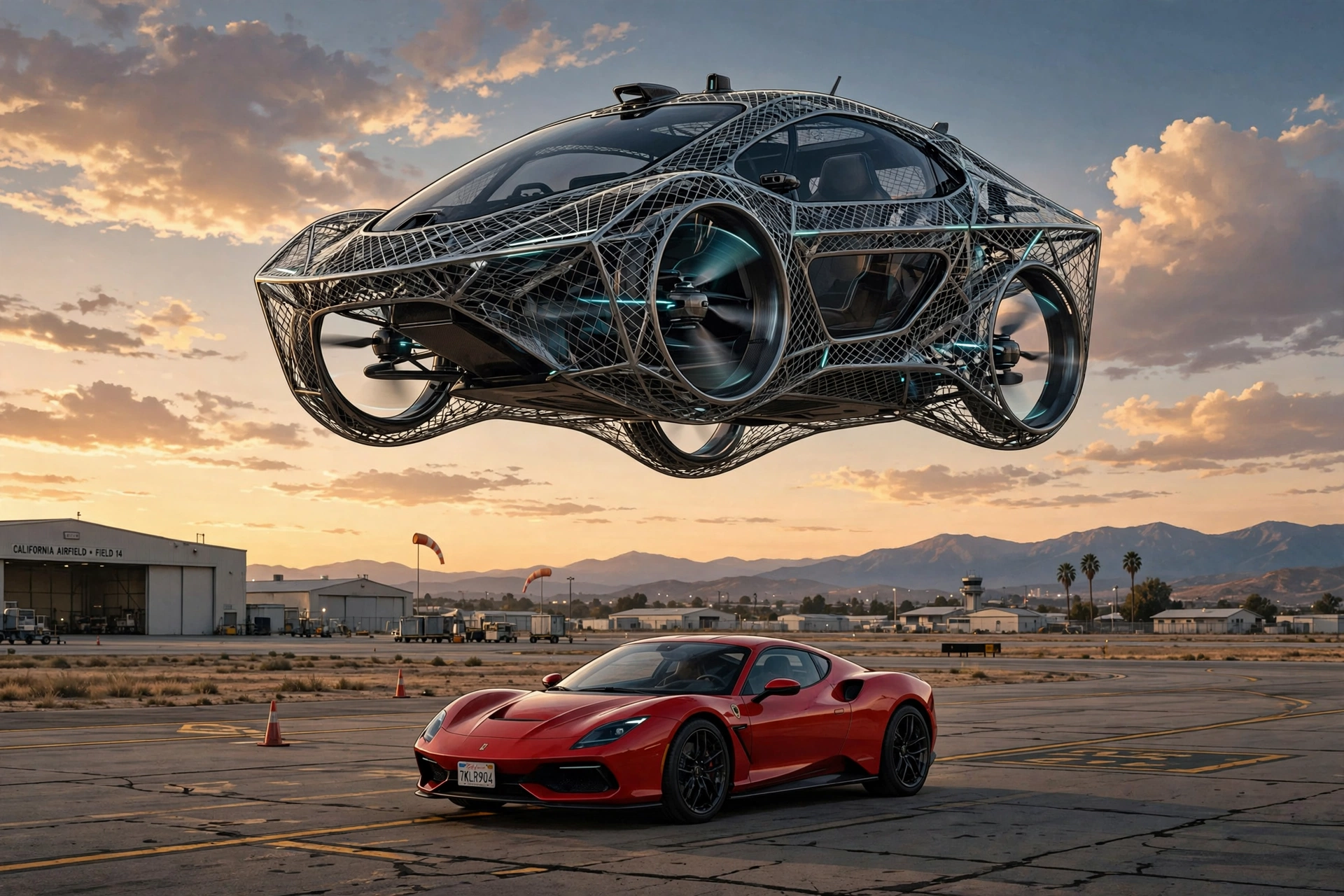
Search “Elon Musk flying car” and you will quickly meet a completely different vehicle: a mesh-bodied car that takes off vertically on eight hidden electric propellers, its body tilting sideways into a wing while the cabin stays upright. That is the Model A from California startup Alef Aeronautics — a company Musk does not own, run by CEO Jim Dukhovny, which has been working on the idea for eleven years (Aerospace Global News). The only documented link between Alef and Musk’s world is a person: venture capitalist Tim Draper, an early investor in Tesla and SpaceX, is also an early investor in Alef (Aerospace Global News). No reputable report shows Tesla, SpaceX or Musk himself owning, buying or funding Alef — the “Musk connection” in viral posts is that one shared investor, inflated.
Alef, unlike Tesla, is building an actual roadable aircraft: it holds a Special Airworthiness Certificate the FAA granted in 2023 — for exhibition, research and development flying only, not commercial passenger use — and it has agreements to run test operations at Half Moon Bay and Hollister airports in Silicon Valley (Aerospace Global News; Notebookcheck). The company cites a target price of roughly $300,000, a driving range of about 220 miles and a flight range of about 110 miles; CNBC counted 2,850 pre-orders worth over $850 million in March 2024, and Alef’s own press materials now put pre-orders above 3,200 — company-reported figures that have not been independently audited (Aerospace Global News; Tech Insider). Alef began hand-building customer cars in December 2025 and targets limited first deliveries, under controlled test conditions, by the end of 2026 (StyleYourItems).
Hours after Tesla’s event, Alef answered it directly: it released video of a Model A lifting off and flying clean over a parked Tesla Roadster and a Cybertruck — billed as its 1,000th logged flight — while calling Tesla’s machine “the second flying car in history, following Alef” (Tech Insider; Aerospace Global News). Even that “first” needs an asterisk: roadable aircraft flew long before either company existed — the Convair Model 118 flew in 1947, the Taylor Aerocar in 1949 — and no flying car from any maker has yet won full certification for unrestricted public use (Aerospace Global News). The same goes for China’s XPeng AeroHT, whose six-wheeled Land Aircraft Carrier — a van carrying a detachable two-seat aircraft, priced around $280,000 — is slated for first customer deliveries in late 2026, though later company comments have pointed to 2027 and sent its first vehicle to Ras Al Khaimah in the UAE for regulatory trials on October 20; it has no connection to Musk whatsoever, despite its footage constantly being relabelled as his (N24; FurtherAsia).
And then there are the outright fakes
Within a day of the real event, the fake version of it was outrunning the original. An AI-generated clip posted by @pingu4ty in the early hours of October 16 showed a driver stuck in a traffic jam pressing a button and blasting vertically out of the queue — it spread across TikTok the same day, and AI-video template sites are now selling the scene as a make-your-own meme (JumpOnTheTrend). A week on, renders showed the Roadster flying over the Leaning Tower of Pisa, lifting off city rooftops and drifting past landmarks — none of which happened; every genuine frame of the car airborne comes from one place, a dark test pad in Texas with a distinctive loop ramp and live telemetry overlays (Yumiza).
The fakes also predate the car. For years, clips of other companies’ aircraft — footage of the Jetson ONE personal flyer among them — have circulated captioned as a “Tesla flying car,” which is one reason so many viewers assumed the genuine October footage must be CGI too (PopularAI). The practical test is the one fact-checkers applied: the real demonstration was livestreamed, in front of a crowd, covered by wire services and corroborated by attendee video. Any “Tesla flying car” clip that cannot be traced back to that night in McGregor should be treated as a render until proven otherwise.

How the car world reacted
The warmest welcome came from the rival Musk had just upstaged. “Welcome, Tesla, to the flying car race; we’ve been here alone for eleven years,” said Alef CEO Jim Dukhovny (Aerospace Global News). Wall Street’s reaction was cooler. Deepwater Management’s Gene Munster called the presentation “an engineering flex with no commercial value beyond embarrassing traditional car makers” in an X post, while Hagerty presenter Henry Catchpole praised the engineering but noted: “How it all translates into a finished, usable, enjoyable road car for enthusiasts remains to be seen” (The Motley Fool). Even sympathetic coverage carried the same footnote: Electrek pointed out that the thrusters appeared to fire before the car started moving on its headline 0–60 run, and the performance figures remain Tesla’s own until an outside tester measures them (Flying Roadster fact check).
What to make of the “Musk flying car”
First, both extreme takes are wrong — and the truth is more interesting than either. The footage is not AI: a real prototype, built by Tesla with SpaceX engineers, really did drive upside down, leap a row of cars and roll in mid-air in front of a live audience, verified by Snopes and wire coverage. But a five-second thruster hop is not the flying car of the viral imagination either. Tesla demonstrated controlled falling with style; it did not demonstrate flight from anywhere to anywhere, which is the problem Alef and XPeng — with propellers, wings and aviation certificates — are actually trying to solve.
Second, the most reliable guide to this product is Musk’s own scepticism. The man who worried in 2017 that an unserviced flying car might drop a hubcap on your head has now built a car he himself calls “not necessarily a safety-optimized,” possibly not legal in all jurisdictions, and sold its full flight system only as an invitation-only variant that cannot be used on public roads. Read the 2015–2017 Musk alongside the 2026 Musk and the Roadster makes sense: not as transport, but as a halo stunt — the SpaceX package teased for the better part of a decade, finally performed once, on a closed pad, with nobody inside.
Third, watch the paperwork, not the videos. Nothing about October 15 changed the regulatory reality: the FAA does not class the Roadster as an aircraft, Alef’s certificate covers testing rather than customers, and no flying car anywhere has full certification for unrestricted public use (Aerospace Global News). The dates that matter now are unglamorous — Tesla’s 2028 production target for a car already six years late, Alef’s limited hand-built deliveries promised by the end of 2026, XPeng’s first customer handovers in China and its UAE trials. If any of those land on schedule, the flying car story becomes real in the only way that counts. Until then, the honest headline is the one Musk himself supplied, a decade early and about everyone else: flying things are easy to love, and very hard to make a scalable solution.