What Is Voice Cloning? Consent, Rules and the Questions Everyone Asks
Voice cloning explained as an FAQ: what it is, whether you may clone your own voice, what counts as consent (OpenAI’s explicit informed consent, Microsoft’s written permission and recorded acknowledgment), why OpenAI kept Voice Engine limited, and what watermarking can and cannot do.
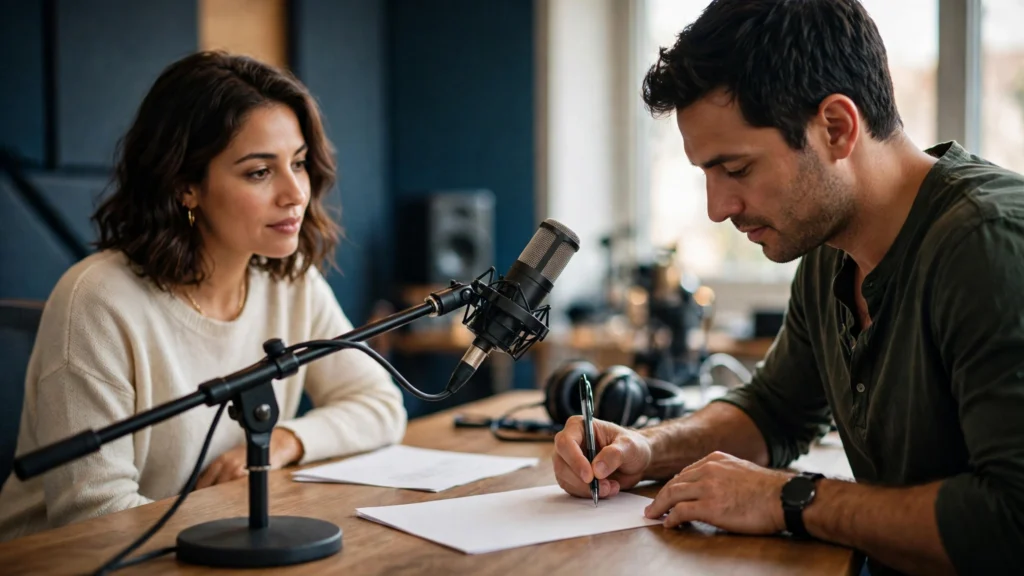
Voice cloning is the part of AI audio that generates the headlines: a system listens to recordings of a person, learns the patterns that make their voice theirs, and can then speak new words in that voice — words the person never said. The questions that follow are practical, not philosophical. Whose voice may you clone? What counts as consent? What do the big platforms require before they will build a clone? And what happens when a clone is used on you? This FAQ answers each from the primary sources: OpenAI’s published Voice Engine policies, Microsoft’s limited-access rules for Custom Neural Voice, and the FTC’s consumer guidance. The general technology overview lives in AI Voice Generators Explained.
Highlights
- What cloning is: a model of one specific person’s voice, built from recordings of them, that can speak text they never recorded.
- The industry consent standard: explicit permission from the speaker, obtained in advance — OpenAI requires “explicit and informed consent from the original speaker”; Microsoft requires written permission from the voice talent.
- Verification is built in: Microsoft makes the talent record an acknowledgment statement and checks it against the training audio with speaker-recognition technology.
- Disclosure travels with the audio: OpenAI’s partners must tell audiences the voices are AI-generated; Microsoft requires customers to disclose the synthetic nature of the service to users.
- Cloning a voice without consent is impersonation — prohibited by platform policies and, when used to defraud, a crime; the FTC tracks voice-cloning scams actively.
What exactly is voice cloning — and how is it different from a normal AI voice?
A stock AI voice is a synthetic persona: built from professional recordings made for that purpose, owned by the provider, and not a copy of anyone in particular. A voice clone is a model of an identifiable person. The system analyses recordings of that one speaker — their pitch range, timbre, accent, rhythm, characteristic phrasing — and produces a generator that imitates them. Modern systems need surprisingly little input, which is why the technology is simultaneously useful (a presenter re-recording one corrected line without a studio) and dangerous (a scammer working from a social-media clip). Google’s price list captures the mainstreaming of the feature: alongside stock voices it sells an “instant custom voice” tier at $60 per million characters — cloning as a line item. Everything else in this FAQ follows from one fact: because the output is a specific person’s identity rendered as audio, the rules around it are the rules around identity, not the rules around software.
May I clone my own voice?
Yes — this is the uncomplicated case, and it is also genuinely useful. Creators clone their own voices to fix narration errors without re-recording, to keep publishing through illness, and to produce versions in a consistent voice at any hour. People who are losing their natural voice to disease have used cloning, recorded while they still can, to keep speaking in a voice their family recognises. Platforms still route self-cloning through their consent machinery — identity verification, recorded acknowledgments — because from the provider’s side, “it is my voice” is itself a claim that needs checking. Microsoft’s process illustrates the pattern: before a custom voice model can be trained, the voice talent must record a predefined acknowledgment statement confirming they know their voice will be used to create a synthetic voice, and Microsoft verifies that statement against the training audio using speaker recognition, to confirm both come from the same person. Expect equivalent steps anywhere reputable. The production workflow once your clone exists is the same as for any voice — see our step-by-step generator guide.
What counts as consent to clone someone else’s voice?
Across the industry sources, three elements repeat. It must be explicit — a person agreeing to be recorded for a podcast has not agreed to be cloned; the permission must name the synthetic-voice use itself. OpenAI’s formulation for its Voice Engine partners is “explicit and informed consent from the original speaker,” paired with a prohibition on impersonating any individual or organization “without consent or legal right.” It should be written or recorded. Microsoft requires customers to warrant that they have obtained explicit written permission from the voice talent before a model is created, to share Microsoft’s disclosure document with the talent in advance, and to obtain the recorded acknowledgment described above. It should be scoped. Sensible agreements specify what the clone may say and where it may be used — a voice licensed for a company’s training videos is not thereby licensed for its advertising, forever, in every medium. If you are the one being asked to consent, those scope questions are your leverage: duration, territory, content categories, revocation. Consent given casually for “a project” and stretched to a permanent, transferable identity asset is the fact pattern behind most disputes in this space.
Why is OpenAI’s Voice Engine not simply public?
Because OpenAI decided the risks of open release outran the benefits, and said so. Rather than launch Voice Engine generally, it previewed the technology with a small set of partners bound by usage policies: no impersonation without consent or legal right, explicit informed consent from original speakers, mandatory disclosure to audiences that voices are AI-generated, watermarking to trace the origin of generated audio, proactive monitoring of use, and a “no-go voice list” to prevent clones of prominent figures. Its published recommendations to society go further — including phasing out voice-based authentication for bank accounts — and its reasoning is instructive for the whole category: when a capability can be misused faster than norms can form, staged release with contractual guardrails is the responsible middle path between secrecy and abandon. Whether or not one agrees, the practical consequence for readers is that reputable cloning is becoming paperwork-heavy by design, and services offering instant celebrity clones with no questions asked are telling you, by that very fact, which side of the line they operate on.
Is it legal to clone a celebrity’s, a colleague’s or a family member’s voice?
Platform policy is the floor, not the ceiling, and the legal exposure stacks up quickly. Cloning a voice to defraud — the family-emergency scam, the fake executive authorising a transfer — is fraud, full stop; the FTC’s consumer alert on voice-cloning scams treats it as a crime pattern and routes victims to ReportFraud.ftc.gov. Cloning for “harmless” entertainment still collides with publicity and privacy rights: a person’s voice is part of their identity, and using a recognisable clone commercially — an advert “narrated” by a famous actor who never agreed — invites the same liability as using their face, plus platform bans under the consent policies quoted above. Even inside a family, consent is the line that matters: cloning a relative’s voice as a joke is a policy violation on reputable platforms precisely because the machinery cannot tell your joke from a scammer’s rehearsal. The defensive side of the same coin — what to do when a cloned voice targets you — is covered in how to spot a cloned voice, and the scam patterns are surveyed in AI myths and scams. (This FAQ summarises documented policies and enforcement patterns; it is not legal advice for a specific situation.)
What is watermarking, and does it make clones safe?
Watermarking embeds an inaudible marker in generated audio identifying it as synthetic and traceable to its source. OpenAI lists it among Voice Engine’s safety measures, alongside monitoring and the no-go list. It helps platforms and investigators after the fact — a viral clip can be checked for provenance — but it has honest limits: watermarks do not stop a scam call in progress, they can be degraded by re-recording a speaker playing the audio aloud, and they only exist on outputs from providers who implement them. Treat watermarking as forensic infrastructure, not as a shield. The shield, for individuals, remains procedural: call-backs, code words, and refusing to treat any voice as self-authenticating.
What this means
Voice cloning is forcing a legal and social upgrade to an assumption as old as speech: that a voice belongs to the person it sounds like. The primary sources in this FAQ show the upgrade happening in real time, and notably it is being written by the technology’s builders before legislators finish catching up — consent as a product requirement, recorded acknowledgments verified by biometrics, disclosure duties that follow the audio, no-go lists for public figures. For US readers, three practical meanings stand out. First, your voice is now an asset with a paperwork trail: if anyone asks to clone it, the scope questions in this article — duration, media, revocation — are worth real money and real risk, and “we just need a quick recording” is never the whole arrangement. Second, consent infrastructure cuts both ways as protection: the same checks that slow down your legitimate project are the ones standing between a scammer and a clone of your mother, which is why the family-side habits in our spotting guide matter more than any platform feature. Third, compared with synthetic images and video — where provenance standards are still forming — voice is where the norm “no consent, no clone” is closest to settled, precisely because the harm arrived early and personally, one frightening phone call at a time. The readers who internalise that norm now, as producers and as family members, will be on the right side of both the law and the technology as the rules harden into statute.
One frontier the current policies only begin to touch is the voice after death. Families and estates are already being asked whether a late actor, singer or grandparent may keep “speaking” in new material, and the consent framework in this FAQ is the only sane way to approach it: permission, given while the person could give it, scoped for exactly this use, with disclosure to every audience. Absent that paper trail, a posthumous clone is not a tribute technology but an appropriation with good intentions — the speaker is the one person who can no longer object. Expect estates, unions and platforms to formalise this next; the direction of travel is unmistakable, from OpenAI’s partner contracts to Microsoft’s acknowledgment statements. The through-line of every rule in this article is respect for a simple idea that technology made easy to forget: a voice is not raw material that happens to sound like someone. It is someone, in one of the oldest forms identity takes, and it deserves the paperwork — and the courtesy — of being treated that way.
Bottom line
Your voice is becoming an asset with rules: consent before cloning, disclosure afterwards, and hard limits on other people’s voices. Treat your own recordings the way the builders now must — as something worth protecting.
Read Next
- How to Spot a Cloned Voice: A Practical Checklist for Calls, Messages and Videos
- AI Voice Generators Explained: How Text-to-Speech AI Works and How to Use It Safely
Sources
- Navigating the challenges and opportunities of synthetic voices — OpenAI (accessed 7 November 2026)
- Limited Access: Custom Neural Voice — Microsoft Learn (accessed 7 November 2026)
- Scammers use AI to enhance their family emergency schemes — Federal Trade Commission (accessed 7 November 2026)
- Text-to-Speech pricing — Google Cloud (accessed 7 November 2026)