

Highlights
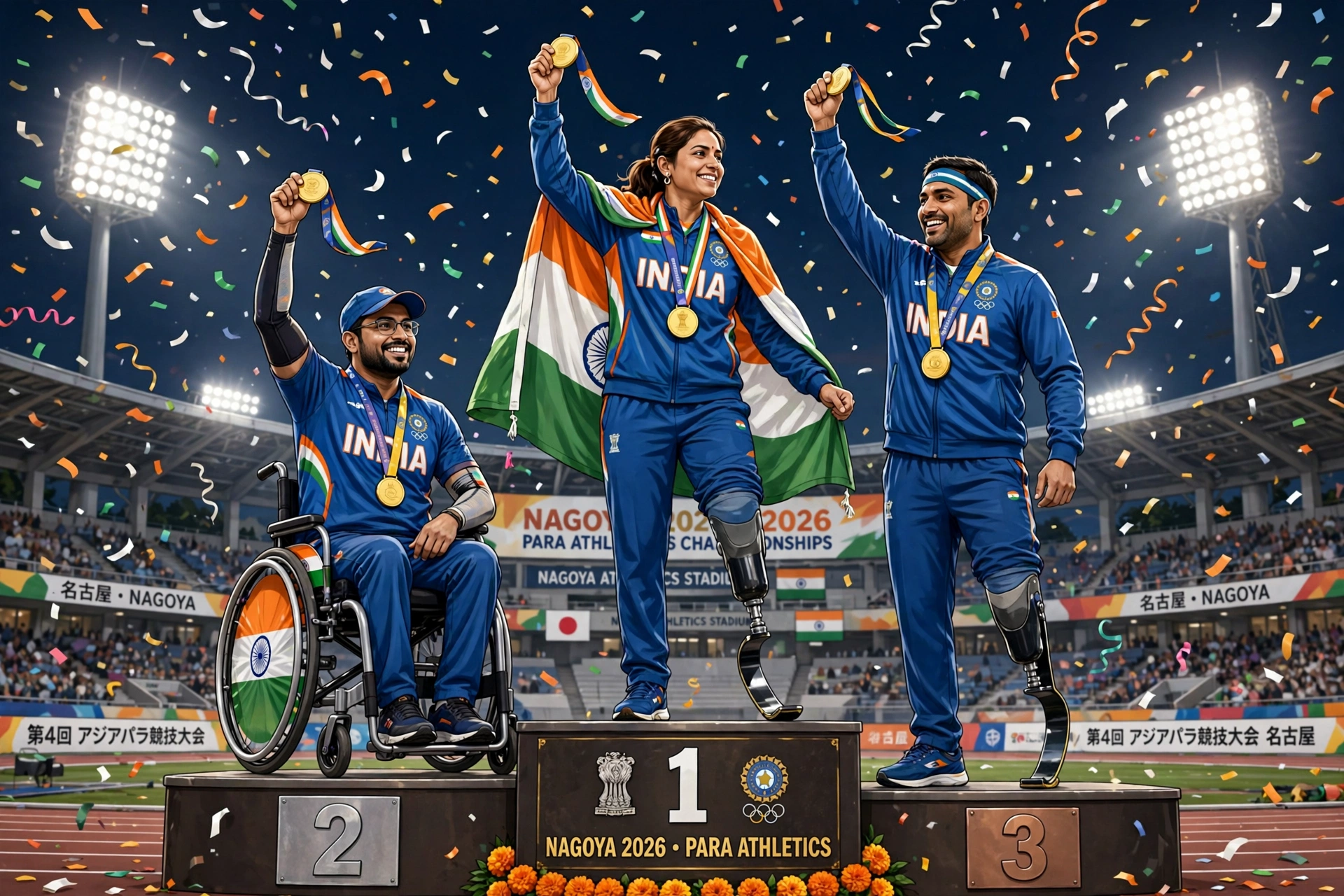
- India finished the Asian Para Games 2026 in Aichi-Nagoya with a record 114 medals — 30 gold, 35 silver and 49 bronze — and a best-ever fourth place in the final standings
- The record was achieved by a contingent of just 168 athletes, barely half the 309 India sent to Hangzhou 2023, where the country’s previous best was set
- Three world records fell to Indians: Haney’s 60.49m javelin throw, debutant Sandeep’s 52.28s in the 400m T64, and Mona Agarwal’s 357.5 in the 50m rifle 3 positions
- Sumit Antil led an all-Indian podium sweep in the javelin, para-athletics delivered 65 medals, and India won nine gold medals on the final day alone — its best single day of the Games
A record that had to survive one last scare
The numbers were confirmed only at the very end. India closed its campaign at the fifth Asian Para Games in Aichi-Nagoya, Japan, with 114 medals — 30 gold, 35 silver and 49 bronze — its highest tally in five editions of the event (Sportstar; Olympics.com).
Fourth place, also a best-ever finish, was not safe until the final day’s events ran out. India had ended its own programme in fourth, but South Korea remained within striking distance: the Koreans needed two more gold medals to draw level with India’s 30, and their superior silver count would then have pushed them ahead (The Times of India). South Korea added three medals on the final day but only one gold, finishing fifth with 29 gold and 100 medals in total, while Iran took sixth (The Times of India).
Above India, the order was familiar. China topped the table for the fifth edition in a row with 435 medals, including 207 gold; hosts Japan were second with 186 medals, and Uzbekistan third with 145 (Sportstar).
Nine golds and three world records: the day that sealed it
India’s campaign ended with its loudest day. The contingent collected nine gold medals on Friday — its biggest single-day gold haul of these Games — with champions emerging from athletics, badminton, archery and shooting (The Economic Times).
Three of those golds rewrote record books. Haney won the men’s javelin throw F37/38 with a throw of 60.49m, setting a new world record in the T37 category (Olympics.com). Debutant Sandeep stormed to the men’s 400m T64 title in a world-record 52.28 seconds — a victory that was also India’s 100th medal of the Games — and later added bronze in the 100m T44 in 11.67 seconds (Mathrubhumi; Olympics.com). And in para shooting, Mona Agarwal’s world record — covered in full below — made her the first Indian para-shooter ever to medal in her event at these Games (Olympics.com).
A podium sweep, an all-Indian final and a wall of doubles
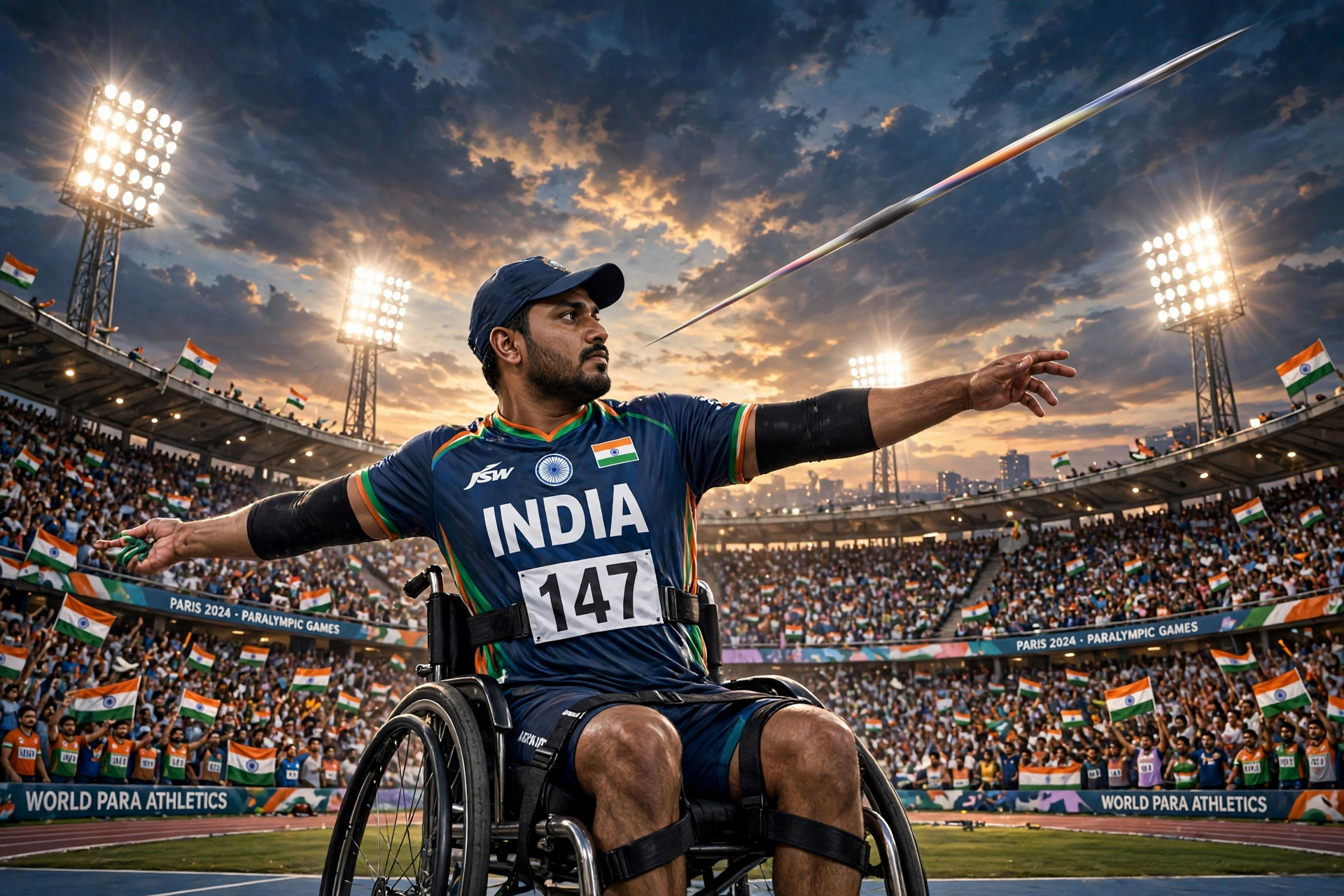
The signature image of India’s week came in the men’s javelin throw F42–F44/F61–F64, where two-time Paralympic champion Sumit Antil led a clean Indian sweep of the podium. Antil took gold in the T64 category with 72.46m, worth 1,112 points under the combined-class scoring system; Mahendra Gurjar claimed silver with a Games-record 59.03m in T42, and Sandip Sanjay Sargar bronze with a Games-record 64.48m in T44 (Olympics.com).
In para badminton, the men’s singles SL3 final was an all-Indian affair: reigning Paralympic champion Nitesh Kumar defeated compatriot and reigning world champion Pramod Bhagat in straight games, 21-18, 21-16 (Olympics.com). Thulasimathi Murugesan and Manasi Joshi then beat reigning world champions Yang Qiuxia and Xiao Zuxian of China 21-16, 21-13 to win the women’s doubles SL3-SU5 gold, improving on their silver from the previous edition (Olympics.com).
The doubles act ran through the whole contingent. Nishad Kumar stepped outside his high jump speciality to win the T47 long jump with 7.11m, then took high jump gold with a Games-record 2.04m (The Times of India). Pranav Soorma claimed the discus F51/52/53 gold with an Asian-record 11.66m and defended his club throw F51 title with a Games record of 32.87m (The Times of India; Olympics.com). Simran Sharma won the women’s 100m and 200m T12 titles, setting a Games record of 12.02s in the 100m (The Times of India). In archery, Sheetal Devi won two golds and a silver, while Harvinder Singh and debutant Vijay Sundi took the men’s recurve doubles title — and Bhawna and Pooja’s silver in the women’s recurve doubles was India’s first-ever medal in that event (Olympics.com; The Times of India).
In all, 26 Indian athletes won multiple medals in Nagoya, and six collected multiple golds (The Times of India).
The champion who won a world-record gold with a rented rifle
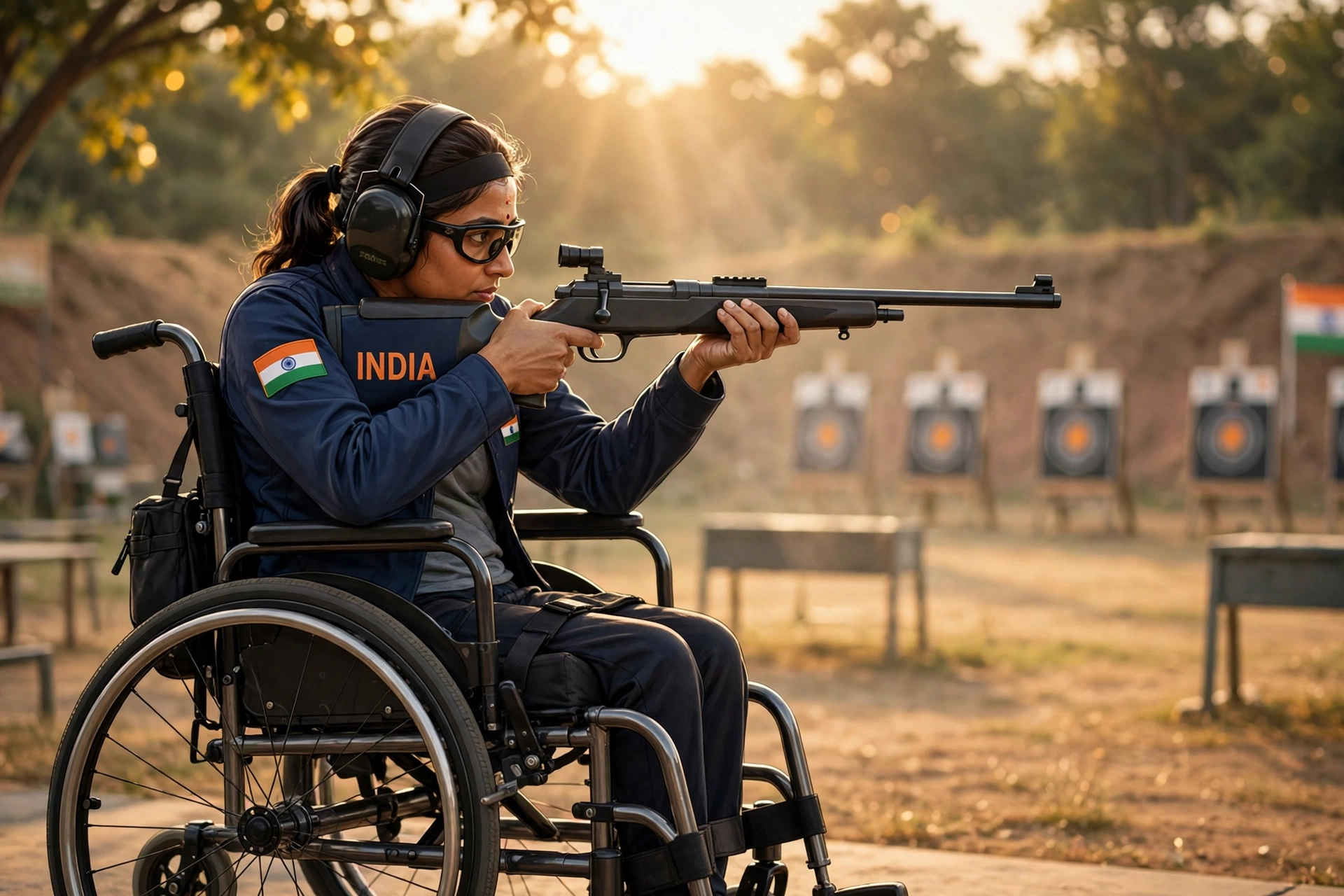
If one story distils India’s week, it belongs to Mona Agarwal. The Jaipur-based shooter won the women’s 10m air rifle standing SH1 gold, then added the 50m rifle 3 positions SH1 title with a score of 357.5 — a new world record and Asian Para Games record, and the first medal by an Indian para-shooter in that event at these Games (Olympics.com; The Times of India).
Then came the detail that turned a gold medal into a legend. Agarwal won it with a borrowed weapon:
“When I decided to train in the 50m rifle, the 50m range was 30km away from my home. I rented a 50m rifle and carried it while riding. I trained three times a week apart from practicing 10m air rifle at the range near my home. Only four months ago, I got my own 50m rifle. But that too had an equipment error. I was competing with a rented rifle here today,” Mona told The Indian Express (The Indian Express).
The double gold medallist was rewarded with the honour of carrying the Indian flag into the closing ceremony alongside fellow double champion Nishad Kumar (Hindusthan Samachar).
From 14 medals to 114: how the record actually reads
India’s first Asian Para Games, at Guangzhou in 2010, produced 14 medals and 15th place. Incheon 2014 brought 33 medals, Jakarta 2018 a breakthrough 72 and ninth place (The Times of India). Aichi-Nagoya is the fifth consecutive edition in which India has improved its tally (The Times of India).
The comparison with the previous best needs one honest footnote, because the record books carry two numbers for Hangzhou 2023. India originally returned from Hangzhou with 111 medals, but the tally was later revised down to 108 — 27 gold, 32 silver and 49 bronze — after doping-related disqualifications and a medal reallocation (The Times of India; Republic World). On either figure, Nagoya’s 114 stands above it — and the gold count rose from 27 to a record 30 (The Times of India).
What makes 114 remarkable is the denominator. India fielded 168 athletes in Aichi-Nagoya — 112 men and 56 women across 11 sports — little more than half the 303 who competed in Hangzhou (The Times of India). On a simple medals-per-athlete measure, India’s return roughly doubled, from about 0.35 medals per athlete in Hangzhou to 0.68 in Nagoya (The Times of India).
The engine, as ever, was para-athletics: 65 medals, including 22 gold — nearly 57 per cent of India’s total. Para badminton added 16, and together the two sports accounted for 81 medals, more than 70 per cent of the haul; swimming contributed 11, archery six and shooting five (The Times of India).
How the nation reacted
Prime Minister Narendra Modi led the tributes on X, in words that captured why this result landed differently from a routine medal rush:
“What an extraordinary achievement by our para-athletes at the just-concluded Asian Para Games 2026! With a record 114 medals, this marks India’s best-ever performance at the Games. This is an occasion of immense pride and joy for the entire nation! I congratulate every member of our contingent for their exceptional determination. Each athlete has contributed to this historic achievement and inspired countless Indians with their accomplishments,” PM Modi wrote on X (The Hawk).
President Droupadi Murmu also congratulated the contingent on the historic finish (Hindusthan Samachar).
Why 114 medals with 168 athletes changes the argument
First, this was efficiency, not scale. Previous Indian medal surges were built partly on bigger squads. Nagoya’s record came from a contingent roughly 46 per cent smaller than Hangzhou’s, with the medals-per-athlete return nearly doubling (The Times of India). That is the signature of a maturing high-performance system: fewer hopefuls, more finalists, more champions. It mirrors the Paralympic arc — from four medals at Rio 2016 to a best-ever 29 at Paris 2024 (The Times of India).
Second, the golds are spreading — but the base is still narrow. For once, the final-day surge was not carried by athletics alone: badminton won three golds on Friday, archery and shooting delivered titles, and debutants like Sandeep and Vijay Sundi stood on top of podiums (The Economic Times). Yet athletics and badminton still supplied more than 70 per cent of all medals (The Times of India). Depth beyond those two sports is the next frontier.
Third, the gap to the podium of nations is now the honest target. India held off South Korea by a single gold to take fourth, but third-placed Uzbekistan finished 31 medals ahead, and China’s 435 remain another universe entirely (Sportstar). Sixteen years ago India won 14 medals and finished 15th. The trajectory — 14, 33, 72, then back-to-back hundreds — says fourth place is a milestone, not a ceiling. Nagoya will be remembered less for the record itself than for proving India no longer needs its biggest team to produce its biggest week.