


Highlights
- The Ministry of Road Transport and Highways has amended the Central Motor Vehicles Rules, 1989, replacing “E85” with “E85 or E100” in the emission provisions (Rule 115) for flex-fuel vehicles — notification G.S.R. 911(E), dated October 23 and notified on Monday, October 26
- E100 may be used only in vehicles designed by manufacturers as flex-fuel vehicles and certified for it; vehicles running on E20 or normal petrol cannot use E85 or E100, and existing owners are not required to switch fuels or modify their vehicles
- The amendment also raises the gross vehicle weight threshold in the relevant emission tables from 3,000 kg to 3,500 kg, and follows draft rules published on April 27 after public objections and suggestions were considered
- The change closes a certification gap exposed in June, when Maruti Suzuki’s Wagon R Flex Fuel — capable of E20 to E100 — had to be certified on E85 because the rules stopped there; no timeline for nationwide E100 fuel availability has been announced
What exactly changed in the rulebook
This story is, at its core, a one-line edit with large consequences. According to the notification issued by the Ministry of Road Transport and Highways, dated October 23, amendments to the Central Motor Vehicles Rules, 1989 “replace references to E85 — a petrol–ethanol blend containing up to 85 per cent ethanol — with ‘E85 or E100’ in specified emission tables” (The Hindu BusinessLine). The Hindu BusinessLine’s second report identifies the instrument directly: “The notification, issued under G.S.R. 911(E), states, ‘E85 or E100 shall be used in the vehicles designed by the original equipment manufacturers as Flex-fuel vehicles'” (The Hindu BusinessLine). It adds that “references to ‘E85’ in multiple provisions of Rule 115, which deals with vehicle emission standards, have been replaced with ‘E85 or E100′” (The Hindu BusinessLine).
The ministry notified the changes on Monday, October 26 (The Telegraph), and the amendments take effect from their publication in the Official Gazette (The Hindu BusinessLine). This was not a surprise move: the final notification “follows draft rules published on April 27, with the ministry saying it had considered the objections and suggestions received” (The Hindu BusinessLine).
Alongside the headline change, the notification also raises the gross vehicle weight threshold in the relevant tables from 3,000 kg to 3,500 kg (The Hindu BusinessLine).
The most important clarification: not for your existing car
Every report of this amendment carries the same warning, because the obvious misreading — that petrol cars can now fill up on pure ethanol — is wrong. A senior road transport ministry official said fuel beyond E20 and up to E100 “is intended only for vehicles designed and certified to use it and will not be applicable for other vehicles,” as PTI reported: “Vehicles that use E20 or normal fuel can’t use E85 or E100 fuel” (The Telegraph). The ministry’s own explanatory note makes the design point in full: “Flex-fuel vehicles are specifically designed with fuel-system components and materials that are compatible with ethanol blends from E20 to E100. Vehicles designed as flex fuel vehicles will not have material compatibility issues. Motorists should check the fuel compatibility sticker on their vehicle and follow the manufacturer’s guidance in the owner’s manual while opting for the fuel choice at the fuel station” (Indian Express).
Existing owners are explicitly out of scope. Ministry officials said: “A vehicle’s compatibility with E10 or E20 alone does not establish its suitability for E85. This notification does not require owners of existing vehicles to switch to E85 or modify their vehicles, either now or in the future. Motorists should check the fuel compatibility sticker on their vehicle and follow the manufacturer’s guidance in the owner’s manual before choosing a fuel at the pump” (The New Indian Express).
What makes a flex-fuel vehicle different is automatic adaptation: such vehicles can run “on petrol, ethanol, or any combination of the two without requiring manual adjustments by the driver,” with sensors detecting the blend and altering fuel injection and ignition timing (Indian Express). One definitional wrinkle is worth flagging: The Hindu BusinessLine calls E100 fuel “containing 100 per cent ethanol” (The Hindu BusinessLine), while The New Indian Express describes it as typically “93-95 per cent ethanol, 5-7 per cent petrol and additives,” produced from feedstocks “such as sugarcane, maize and biomass” (The New Indian Express). Most coverage settles on “nearly pure ethanol” — the safest description until the fuel is widely sold.
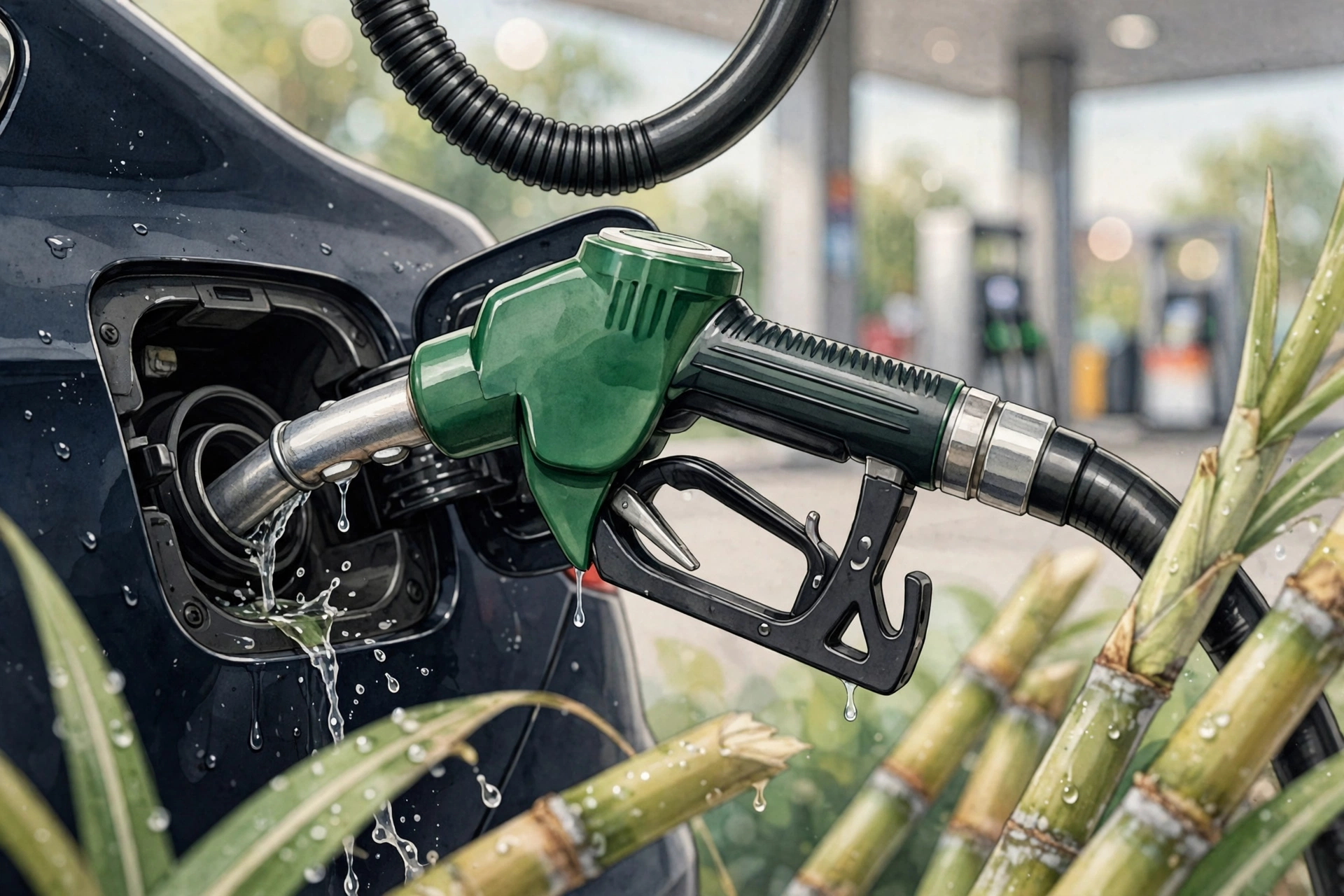
Why the rule had to change: the Wagon R problem
The clearest explanation for this amendment is a car that already exists. In June, Maruti Suzuki launched India’s first flex-fuel passenger vehicle, the Wagon R Flex Fuel, “capable of running on ethanol-petrol blends from E20 to E100” (The Telegraph). But capability and certification were two different things: at that launch, the automaker said the vehicle “could operate on blends ranging from E20 to E100, but had been certified using E85 because the applicable rules defined flex fuel as E20 to E85” (The Hindu BusinessLine). In other words, the hardware had outrun the rulebook. This week’s amendment closes that gap — a flex-fuel model can now be certified across the full range it was engineered for.
At that June launch, Road Transport Minister Nitin Gadkari said: “Flex-Fuel Vehicles can create a strong and sustainable demand for ethanol, benefiting our farmers, industry, and the environment together” (The Telegraph). Other makers are moving the same way: Toyota Motor Corporation, Tata Motors and Hyundai Motor Company “are also developing flex-fuel vehicles for the Indian market” (The New Indian Express).
Where this sits after E20 — and what is still missing
The sequencing matters. E20 — 20% ethanol blended with petrol — “is the nationwide base fuel,” while E85 “has been introduced separately for vehicles specifically designed and certified to use it” (The Hindu BusinessLine). And the government has kept the base-fuel story separate: “in July, the Petroleum Ministry said that no decision had been taken to raise the nationwide base blending level beyond 20 per cent” (The Hindu BusinessLine). The E100 change is about what a specially built vehicle is allowed to run on, not about what will be in every pump — the regulation “paves the way for the manufacturing and supply of more flex-fuel vehicle components, ethanol production infrastructure, and the deployment of such vehicles on the road” (Indian Express).
The stated reasons are energy security and emissions. The ministry said: “Ethanol has a lower fossil carbon footprint than conventional gasoline. The use of higher ethanol blends can help reduce tailpipe emissions of carbon monoxide (CO) and certain hydrocarbons (HC), while contributing to lower lifecycle greenhouse-gas emissions, depending on the feedstock and production pathway” (Indian Express).

What the notification does not do is just as important. It “does not announce any timeline for the commercial availability of E100 fuel across the country” (The Hindu BusinessLine), and none of the reports we opened puts a price on E100 — so any claim about what it will cost at the pump would be a guess, and we are not making one. The nearer-term supply story is E85: the Petroleum Ministry launched an E85 rollout across 48 public sector oil marketing company outlets in June and announced plans “to expand availability to 500 outlets by December 2026 and about 5,000 outlets by December 2027” (The Hindu BusinessLine). Whether E100 follows the same outlet-by-outlet path, and when, is the open question this amendment leaves behind.
The bottom line: India has spent years treating ethanol as something blended into petrol. This amendment treats it, for the first time in the emission rulebook, as a fuel in its own right — for the small but growing class of vehicles built to take it. That is a regulatory milestone, not a forecourt revolution, and the distinction will decide how carmakers plan their next models. We are watching similar rule-versus-market gaps elsewhere in the auto industry, including in our report on Audi’s first US plant in Georgia. For Indian buyers, the practical advice in the rules is unchanged and simple: check the compatibility sticker, follow the manual — and if your car says E20, E100 is not for you, no matter what the headline says.